
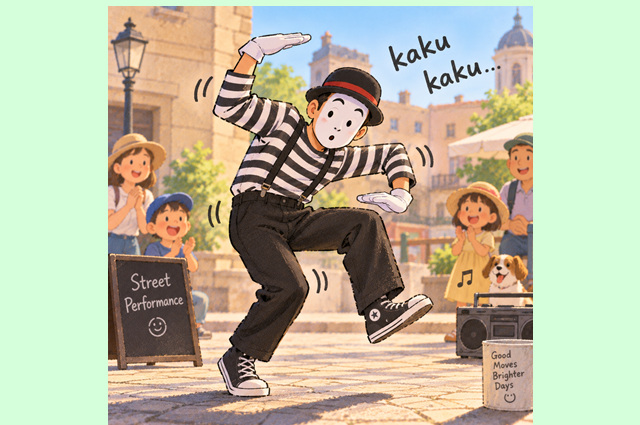
Have you ever seen a robot moving in stiff, mechanical steps instead of moving smoothly?
Or noticed handwriting made up of sharp, angular strokes rather than soft, flowing curves?
That angular, unsmooth quality in Japanese can be expressed as:
“Kaku Kaku” (かくかく)
Let’s hear how it sounds!

What is “Kaku Kaku” (かくかく)?
“Kaku Kaku” describes:
- Stiff or jerky movement instead of smooth motion
- Shapes or lines with noticeable angles and corners
- Angular handwriting with sharp, straight strokes
It gives the impression of something made up of distinct angles or separate movements, rather than flowing smoothly or forming gentle curves.

Pronunciation
kah-koo kah-koo
(Say it with a slightly stiff, separated rhythm, like a movement that changes direction in little steps.)
Categories
Visual / Motion
What Does “Kaku Kaku” Look Like?
It looks like a robot moving with stiff, mechanical motions.
Handwriting formed with sharp, angular strokes.
A line that changes direction in sharp angles instead of forming a smooth curve.

How Do You Say It?
Say it with a slightly stiff, broken rhythm:
Kaku kaku…
Like something moving or changing direction in small, angular steps instead of flowing smoothly.
Example in Daily Life
Example: A robot moving stiffly
The robot turned its arms and legs in stiff, mechanical movements —
kaku kaku…
Each movement seemed separate instead of flowing smoothly into the next.

Cultural Note
In English, you might say:
- “Angular”
- “Stiff”
- “Jerky”
But “kaku kaku” can connect both shape and movement through the same image of sharp angles and a lack of smoothness.
For movement, it can describe something that moves stiffly or in separate, jerky steps. For shapes, lines, or handwriting, it can describe something noticeably angular rather than rounded or flowing.
This makes “kaku kaku” interesting: something can almost seem to have “corners” even when what you are describing is movement.
It suggests:
Angular shapes
Stiff, segmented movement
A lack of smooth curves or flow
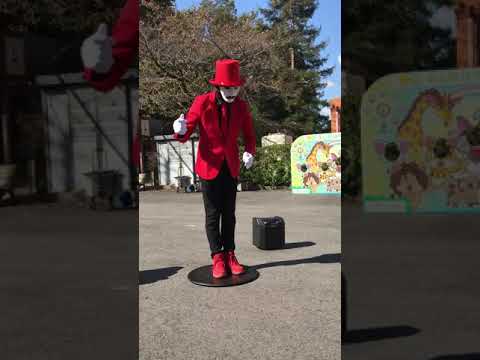
Watch & Feel the “Kaku Kaku” World!
Feel the “Kaku Kaku”
Try Using It!
When a robot moves in stiff, separate motions…
When handwriting looks sharp and angular…
When something changes direction in little steps instead of moving smoothly…
Say it with a slightly stiff rhythm:
Kaku kaku…
Sometimes even movement can feel as if it has corners.













Comments