
Ever felt your stomach growl so loud you couldn’t ignore it?
Or bowed repeatedly when thanking someone?
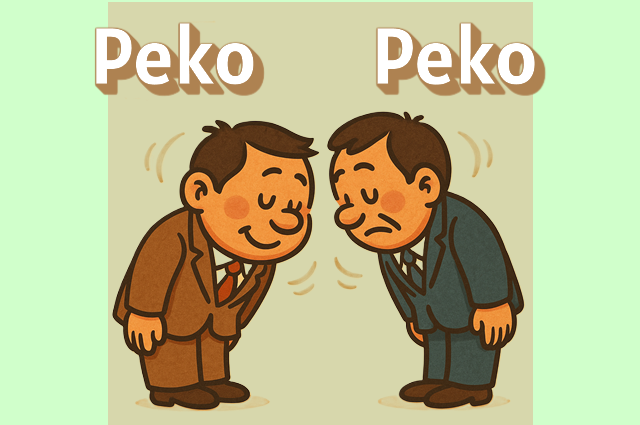
That’s when the Japanese onomatopoeia “peko peko” (ぺこぺこ) comes in —
a sound and rhythm that expresses both emptiness and humility.
Before we dive in, hear what it sounds like!

What is “Peko Peko” (ぺこぺこ)?
“Peko peko” has two main meanings depending on context:
- Hunger – when your stomach feels empty or growls.
- Politeness or Bowing – when someone bows repeatedly to show gratitude or apology.
It captures the motion and rhythm of both hunger pangs and humble gestures.
Pronunciation
peh-ko peh-ko
(Say it lightly and rhythmically — almost like your stomach is knocking softly.)
Categories
Motion
What Does “Peko Peko” Look Like?
It looks like a rumbling stomach,
or a person bowing earnestly over and over.
It’s rhythmic, a little funny, and very human.

How Do You Say It?
Say it with a small bounce in your voice:
Peko peko!
It sounds gentle when used for bowing,
and a little desperate when used for hunger.
Examples in Daily Life
Example 1: Hungry feeling
After skipping lunch,
her stomach growled loudly —
peko peko…

Example 2: Polite bowing
He kept bowing to his boss,
thanking again and again —
peko peko…

Cultural Note
“Peko peko” embodies two sides of Japanese culture —
physical need (hunger) and social grace (humility).
In English, you might say:
- “I’m starving!”
- “He bowed again and again.”
But “peko peko” carries a lighthearted, rhythmic sound that makes both situations feel charming rather than heavy.
Watch & Feel the “Peko Peko” World!
Feel the rhythm of peko peko

Try Using It!
When your stomach growls…
or when you bow in gratitude…
say it cheerfully:
Peko peko〜!








Comments