
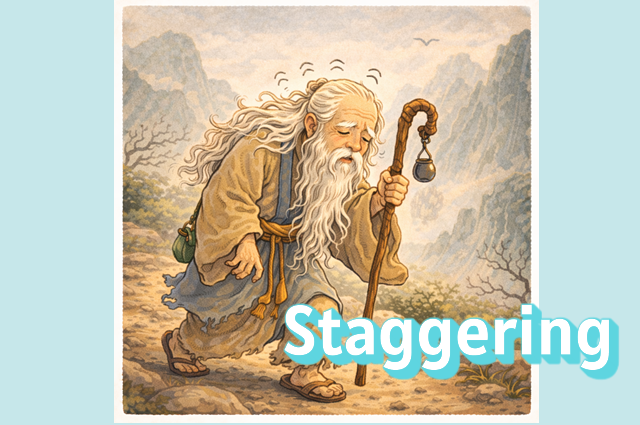
In English, we describe unstable movement as:
- Staggering
- Wobbling
- Swaying
- About to collapse
It’s the movement of someone who has lost balance — from exhaustion, dizziness, or maybe even too much to drink.
But how does Japanese capture that fragile, barely-standing moment with a repeating sound?
Let’s step into the world of Japanese onomatopoeia and discover the sound of losing balance.

What Is a “Staggering” Moment?
It’s when:
- Someone walks unsteadily
- A character is completely exhausted
- A drunk person sways side to side
- Someone looks like they might fall any second
In English, we might say:
- Staggering – Walking with difficulty
- Wobbling – Moving unsteadily
- Swaying – Rocking gently side to side
- On the verge of collapse – Almost falling
But Japanese turns that instability into rhythm.

How Is This Feeling Expressed in Japanese?
Japanese often repeats syllables to express continuous movement.
The standout word for staggering, unstable walking is:
“Yoro Yoro” (よろよろ)
It captures that weak, wavering motion — just before someone falls.
Let’s feel how it sounds.
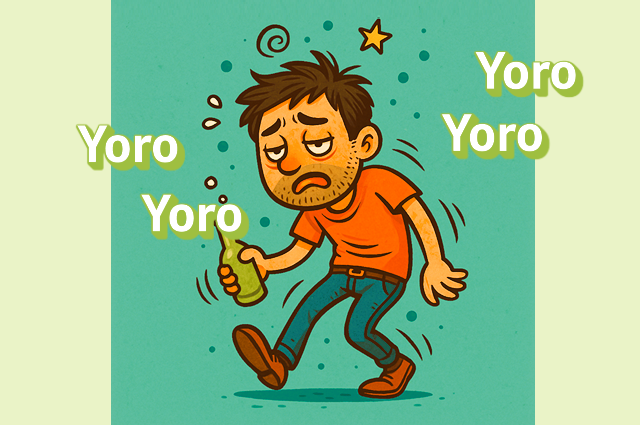
What Is Japanese Onomatopoeia “Yoro Yoro (よろよろ)” ?
“Yoro Yoro” describes:
Physical Weakness
- Someone exhausted after running
- A sick person walking slowly
- A character who has lost strength
Drunken or Dizzy Movement
- Swaying from side to side
- Nearly losing balance
- About to collapse
It’s slower and heavier than playful wobbling.
Unlike “fura fura” (wandering or light dizziness),
“yoro yoro” feels more fragile — like strength is draining away.
It’s the sound of instability at its limit.
Pronunciation
yo-ro-yo-ro
Categories
Motion / Condition
Examples in Daily Life
To learn about how it appears in manga or daily conversation, dive into the following page:
Examples














Comments