
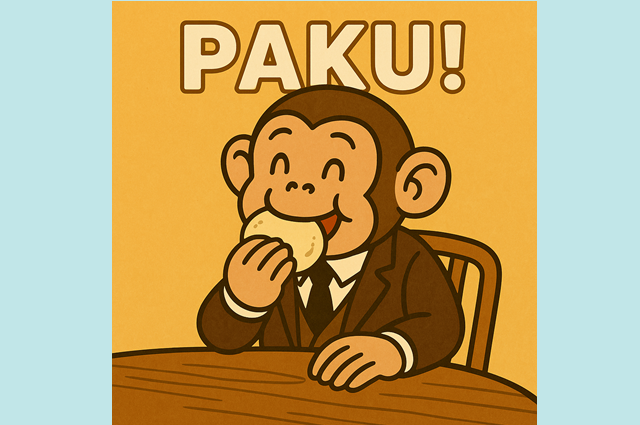
Ever watched someone open their mouth wide and take a big bite of a rice ball, sandwich, or cake?
That soft, sudden, satisfying movement — in Japanese, we say:
Paku! (ぱくっ!)
It’s the perfect sound for describing a single, decisive mouthful.

What is “Paku” (ぱくっ)?
“Paku” is a Japanese onomatopoeia that captures the moment of placing something (usually food) into the mouth with a clean, cute motion.
It’s often used for:
- Taking a bite of food
- Opening one’s mouth wide
- Something being “snapped up” playfully
This sound is widely used in anime, children’s books, and casual speech — and often adds a touch of cuteness or comedy.
Pronunciation
pah-koo
(short, quick, with a pop-like roundness at the end)
Categories
Motion
What Does “Paku” Look Like?
Imagine a kid taking a bite of a big melon bread.
Or a cartoon bear eating a fish in one gulp.
Or even a heart being stolen in a romantic manga panel…
Paku! is always soft, playful, and decisive.

How Do You Say It?
Say it with a smile — like you’re eating something delicious:
Paku!
Example in Daily Life
Example: Bite time!
She picked up the rice ball,
and with a cheerful grin —
paku!

Cultural Note
In English, you might just say “bite!” or “nom” — but “paku” adds softness and visual cuteness.
Think of it like the “munch” or “pop” of Japanese food culture — especially in anime and manga.
Watch & Feel the “Paku!” World
Feel the “Paku!” — A Bite of Pizza

Try Using It!
Watching someone eat cake with a smile? → Say paku!
Playing with a plushie pretending to eat? → Say paku!
The moment something enters the mouth — just say:
Paku!








Comments