

Ever heard someone stifle a giggle in a quiet room?
Or chuckled quietly at a joke you didn’t want others to hear?
That’s when the Japanese onomatopoeia “Kusu” or “Kusu Kusu” (くすっ / くすくす) gently slips out —
a tiny laugh that expresses quiet amusement, subtle emotion, or playful restraint.
Let’s hear it… softly:

What is “Kusu” (くすっ)?
“Kusu” (often written with a small っ for a clipped feel: くすっ) is a soft laugh —
a sound of holding back a smile or laughing to yourself.

You’ll often hear it when:
- Someone chuckles at something only they noticed
- A joke is subtle or slightly awkward
- A character is secretly enjoying a situation
Nuance:
- Small and internal
- Playful or ironic
- Sometimes quietly mischievous
Pronunciation
kus’ (くすっ)
(Say it like a breath through the nose — short, gentle, and soft.)

Category
Sound
What Does “Kusu” Look Like?
- A smile peeking from behind a book
- A comic panel with a tiny laugh bubble
- Someone trying to stay serious but failing
- A character with narrowed eyes and a grin

How Do You Say It?
Say it gently, like a breathy laugh you’re trying to hold in:
Kusu… kusu…
Example in Daily Life
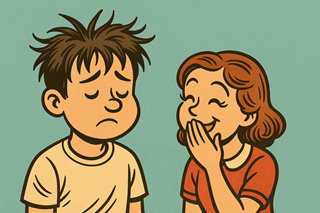
Messy hair
She glanced at his messy hair,
and couldn’t help but chuckle —
kusu…
Cultural Note
In English, you might hear:
- “Hehe”
- “Snicker”
- “Snort”
But “Kusu” is softer, more polite, and feels more Japanese in its restraint.
It’s commonly used in manga and dramas to show controlled emotion, often cute, ironic, or passive-aggressive.
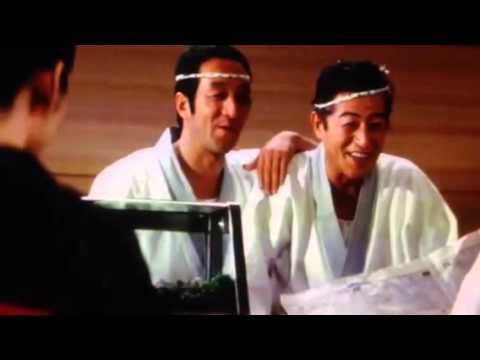
Watch & Feel the “Kusu” World
Feel the “Kusu” — Quiet Chucking
Try Using It!
Next time you:
- Laugh inwardly
- Want to smile gently
- Find something quietly funny…
Say it lightly:
Kusu.








Comments