
Pikachu is one of the most iconic Pokémon in the world—
a small, yellow creature with pointy ears, red cheeks, and a lightning-fast tail.
It’s the face of the Pokémon franchise and a global symbol of cuteness and energy.
But the name “Pikachu” isn’t just cute—it’s also deeply sound-based.

Where Does the Name Come From?
The name “Pikachu” is made up of two Japanese sound words:
Pika (ぴか)
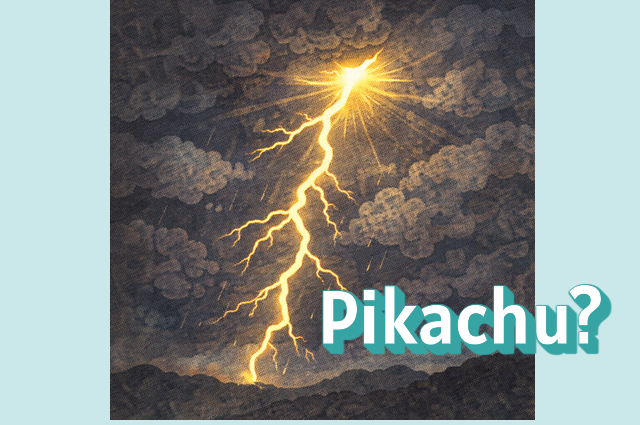
The sparkling, flashing sound of electricity or light
→ like lightning or a camera flash

Chu (ちゅう)
The squeaky sound of a mouse
→ like “chū chū”, the Japanese onomatopoeia for a mouse’s cry

Put them together, and you get Pikachu—
a sparkling, squeaky little electric mouse!
It’s a name that sounds like what Pikachu is.

Why Is It a Sound-born Name?
“Pikachu” is a classic sound-born name:
a name created from the sounds that describe both its power and its personality.
- “Pika” gives you the energy, speed, and brightness.
- “Chu” gives you the small, squeaky, mouse-like feeling.
It doesn’t just label the character—it expresses it.
It’s onomatopoeia turned into identity.
Simple, sonic, and full of charm.

How Did It Spread Globally?
Unlike many Pokémon whose names change in translation,
Pikachu kept its name all over the world.
Why?
Because the sound is the meaning.
“Pikachu” sounds adorable, energetic, and unique—
no matter what language you speak.
Its rhythm, its syllables, and its emotional tone are universal.
People don’t need to translate it—they just feel it.
Final Thoughts
“Pikachu” is more than a name.
It’s a soundscape—a tiny spark wrapped in cuteness.
It proves that names don’t always need logic or explanation—
sometimes, they just need to feel right.
In that way, Pikachu’s name is like a perfect electric chord:
short, sharp, and unforgettable.













Comments