

Ever stepped outside on a cloudy day when everything feels gray and still?
Or been in a room where the mood is just… heavy?
That’s when Japanese speakers use the sound “Donyori” (どんより) —
a soft, foggy word that captures cloudiness, both in the sky and in the air around you.
Let’s hear how it sounds:
What is “Donyori” (どんより)?
“Donyori” is used to describe:
- Cloudy, overcast skies
- Heavy, motionless air
- A gloomy or depressed mood in a space or person
It doesn’t refer to a specific sound — instead, it expresses the atmosphere.

Pronunciation
don-yo-ri
(Slow and soft. Stretch it gently to match the feeling of stillness.)
Categories
Condition / Emotion
What Does “Donyori” Look Like?
It looks like a gray sky with no sunlight.
Like a quiet train station before a storm.
Like a silent classroom after a tough exam.

How Do You Say It?
Say it slowly, like fog rolling in:
Donnn… yorii…
Let the syllables drag slightly to match the feeling.
Examples in Daily Life
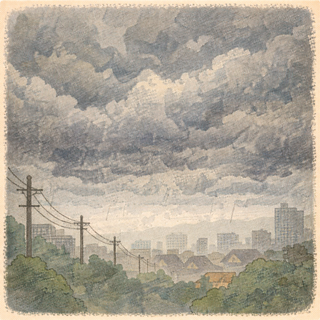
Example 1: Gloomy sky
The clouds hung low,
the air was thick —
donyori all morning.
Example 2: Heavy mood
After the news,
the whole room felt donyori…

Cultural Note
In English, we might say:
- “Overcast”
- “Gloomy”
- “A heavy mood”
But donyori lets you feel the stillness —
as if the air and time itself have slowed down.
Commonly used for both weather and emotions in Japan.
Watch & Feel the “Donyori” World!
Feel the “Donyori” — Gloomy Sky

Try Using It!
When the sky is gray…
When the mood is low…
Whisper softly:
Donyori…













Comments