
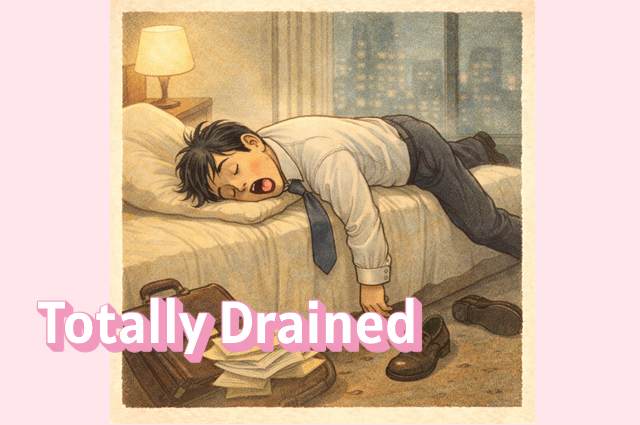
In English-language anime and manga, extreme tiredness is often described with words like “Exhausted,” “Worn Out,” or “Totally Drained.”
These are the moments when a character collapses onto a couch after a long day,
or slumps forward with zero energy left.
But how is that deep, limp exhaustion expressed in Japanese?
Let’s step into the world of anime and manga and discover how Japanese mimetic words capture total fatigue.
What Is a “Completely Exhausted” Moment?
It’s not just “a little tired.”
It’s when:
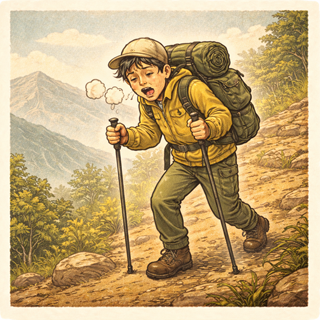
- your shoulders drop
- your steps drag
- your body feels heavy and loose
- you can’t even pretend to be energetic
In anime and manga, this happens after:
- intense training
- a long shift at work
- emotional stress
- running until you can’t anymore
In English, these moments are described as:
- Exhausted – Completely out of energy
- Worn Out – Used up physically or mentally
- Totally Drained – No strength left at all
- Beat – Informal slang for extreme tiredness
So how does Japanese express this limp, strengthless state?
How Is This Feeling Expressed in Japanese?
Japanese often uses mimetic words (gitaigo) to describe physical sensations — even when there’s no actual sound.
The standout word for deep, drained exhaustion is:
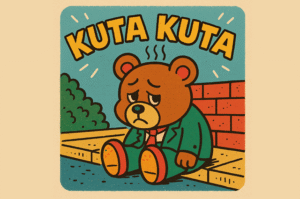
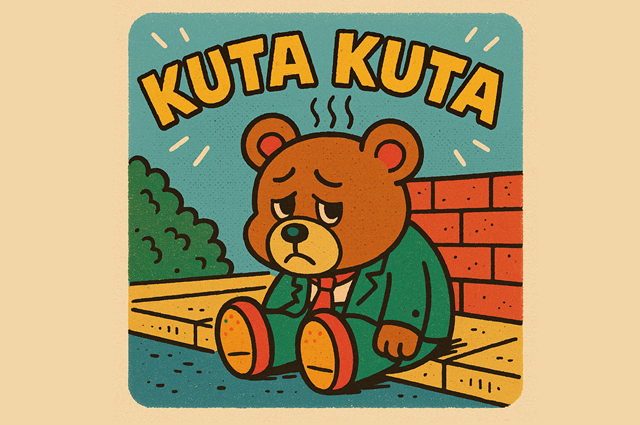
“Kuta Kuta” (くたくた)
It captures the feeling of your body going limp after all your energy has drained away.
Let’s feel how it sounds.
What Is Japanese Onomatopoeia “Kuta Kuta (くたくた)” ?
“Kuta Kuta” expresses deep tiredness or limpness — when all your strength has drained away.
It’s a core gitaigo (mimetic word) for physical sensations, not a sound.
Used for:
- Someone who looks utterly tired or sluggish
- Being completely exhausted after work or exercise
- Food that has become too soft from boiling too long
It’s not dramatic like “collapse.”
It’s the slow, droopy state after the collapse.
Your body feels soft.
Loose.
Unstructured.
Even overboiled vegetables can become くたくた —
soft, limp, and lacking firmness.
Pronunciation
koo-tah koo-tah
(say it weakly, as if your voice itself is tired)
Categories
Condition / Emotion / Visual
Examples in Daily Life
To learn about how it appears in manga or daily conversation, dive into the following page:
Examples










Comments