
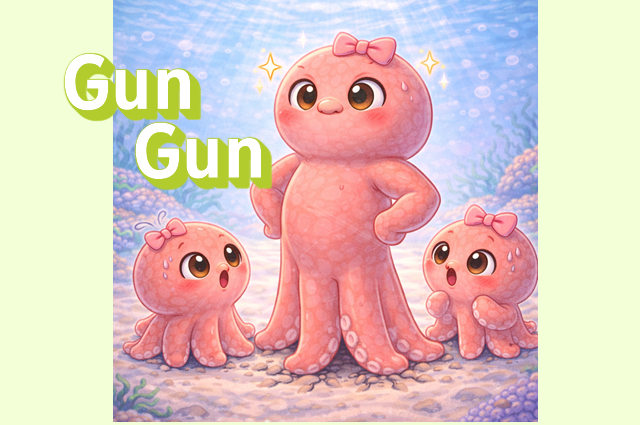
Have you ever seen something grow quickly — almost right before your eyes?
Or felt yourself improving faster and faster?
That sense of steady, powerful progress in Japanese is expressed as:
“Gun Gun” (ぐんぐん)
Let’s hear how it sounds!

What is “Gun Gun” (ぐんぐん)?
“Gun Gun” describes:
- Rapid, noticeable growth
- Strong, continuous progress or improvement
- Movement that advances with energy and momentum
It’s often used when something is not just increasing —
but doing so visibly and confidently.

Pronunciation
goon goon
(Say it firmly and forward — like something pushing ahead.)
Category
Motion

What Does “Gun Gun” Look Like?
It looks like a plant growing taller day by day.
Like a child getting better at something quickly.
Like something rising with clear momentum.

How Do You Say It?
Say it with strength and forward motion:
Gun gun!
Like something pushing ahead —
step by step, with energy.
Examples in Daily Life
Example 1: Growing quickly
The plant grew taller every day —
gun gun!

Example 2: Improving skills
She practiced every day,
and her skills improved —
gun gun.

Cultural Note
In English, you might say:
- “Rapidly”
- “Quickly improving”
- “Growing fast”
But “gun gun” adds a strong sense of:
Visible progress
Energy and momentum
Continuous forward movement
Watch & Feel the “Gun Gun” World!
Feel the “Gun Gun” — Bamboo Shoot

Try Using It!
When something grows quickly…
When you improve fast…
When progress feels strong and clear…
Say it with energy:
Gun gun!









Comments