
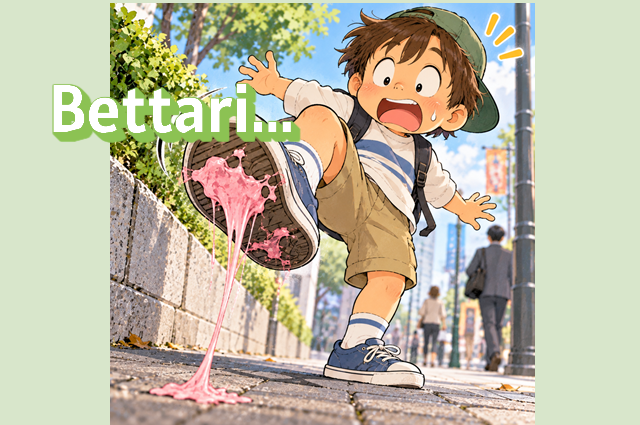
Have you ever seen something stuck so closely to a surface that there seemed to be no space between them?
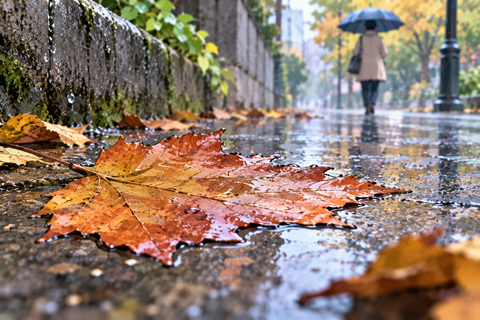
Maybe a wet leaf was stuck flat against the pavement, as if it did not want to come off.
That close, heavy kind of sticking in Japanese can be expressed as:
“Bettari” (べったり)
Let’s hear how it sounds!
What is “Bettari” (べったり)?
“Bettari” describes:
- Something sticking closely against another surface
- Broad, close contact with little or no space in between
- A heavy or persistent kind of closeness that can feel difficult to separate
It gives the impression of something pressed or stuck closely against something else, often over a noticeable area rather than at just one small point.
Pronunciation
bet-tah-ree
(Give the small “っ” a brief stop, then let the rest of the word follow with a slightly heavy feeling.)
Category
Condition / Texture
What Does “Bettari” Look Like?
A wet leaf stuck flat against the pavement.
Wet clothes clinging closely to someone’s skin.
Something pressed against a surface with almost no space left between them.

How Do You Say It?
Say it with a brief stop in the middle and a slightly heavy rhythm:
Bettari…
Like something has settled closely against a surface and does not seem eager to come away.
Example in Daily Life
Example: A wet leaf stuck to the pavement
After the rain, a large wet leaf was stuck flat against the pavement —
bettari…
Its whole surface seemed to cling closely to the ground, with almost no space underneath.
Cultural Note
In English, you might say:
- “Stuck firmly”
- “Clinging”
- “Plastered against”
But “bettari” does not simply mean that two things are touching. It often makes you imagine a broader area of close contact, with little or no space between the surfaces.
Sometimes actual stickiness or moisture causes this closeness, as with a wet leaf on the ground or wet fabric against skin. But something does not always have to be literally sticky to be described as bettari.
The expression often carries a sense of weight or persistence: the two things seem closely attached rather than merely touching lightly.
It suggests:
Close contact over a surface
Little or no space in between
A heavy, persistent kind of attachment
Watch & Feel the “Bettari” World!
Feel the “Bettari”

Try Using It!
When a wet leaf is stuck flat against the pavement…
When wet clothes cling closely to someone’s skin…
When something is pressed closely against a surface with almost no space between them…
Say it with a slightly heavy feeling:
Bettari…
“Bettari” is more than touching — it feels like the whole surface has joined in.
More Condition-based Onomatopoeia








Comments