
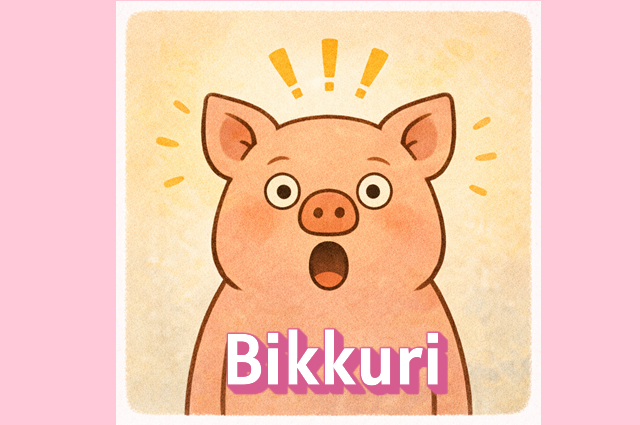
Ever turned around and suddenly saw someone standing right behind you?
Or heard a loud noise that made your heart jump?
That’s when the Japanese word “Bikkuri” comes in — a common, emotional reaction word meaning “surprised!”
Even though it sounds like an onomatopoeia, it’s not officially categorized as one — it’s an almost onomatopoeia, mimicking a startled response.
Before we dive in, hear what it sounds like!
What is “Bikkuri” (びっくり)?
“Bikkuri” expresses a reaction of sudden surprise or shock.
It’s used when you’re startled — emotionally or physically — by something unexpected.
Unlike true sound-symbolic words, “bikkuri” behaves like a verbal noun:
e.g. bikkuri suru (to be surprised).
Pronunciation
bik-ku-ri
(A quick “bi!” and a soft ending — like the jump in your chest when surprised.)
Categories
Emotion
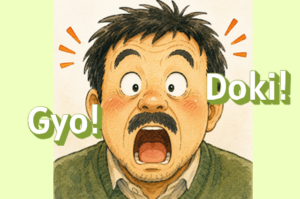
What Does “Bikkuri” Look Like?
It looks like wide-open eyes.
A jump backward.
A gasp — or a freeze — when caught off guard.

How Do You Say It?
Say it with a little breath of shock:
Bikkuri shita!
“I was surprised!”
Or softly to yourself:
Bikkuri…
(“Oh wow…”)
Examples in Daily Life
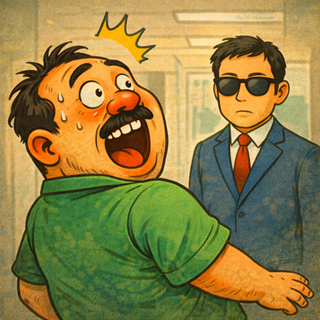
Example 1: Surprise encounter
He turned around —
and someone was standing right there!
Bikkuri shita…!
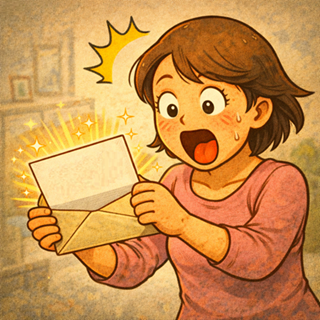
Example 2: Unexpected result
She opened the envelope
and found she’d won the prize!
Bikkuri!
Cultural Note
Unlike the short shock-like “Biku!” (which is a true onomatopoeia),
“Bikkuri” is a reaction word that became widely used like a verb: Bikkuri Suru (to be startled).
That’s why it’s considered an almost onomatopoeia.
In English, it might be:
“Whoa!” / “Oh my gosh!” / “I was startled!”
Watch & Feel the “Bikkuri” World!
Feel the “Bikkuri” — Surprise Moment
Try Using It!
Someone suddenly calls your name?
You hear thunder right outside the window?
Get a jump scare in a movie?
Try saying:
Bikkuri!








Comments