
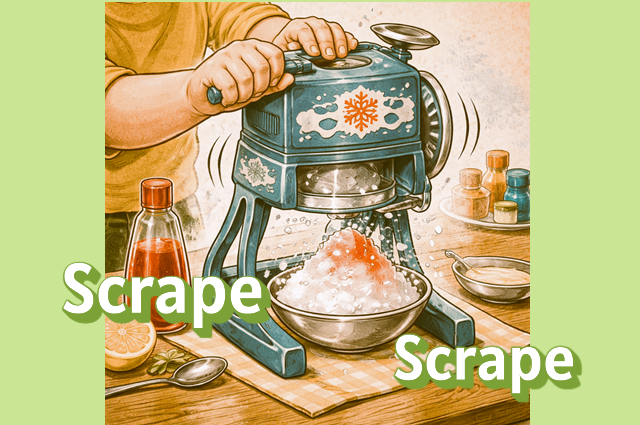
In English, we describe rough scraping or hard crunching sounds as:
- Crunch crunch
- Scrape scrape
- Grinding
- Scratch scratch
It’s the sound of something hard and dry being pressed, scraped, or bitten.
Think of chewing ice, scratching something rough, or a pencil scraping across paper.
But how does Japanese capture that sharp, dry, repetitive sound with a repeating rhythm?
Let’s step into the world of Japanese onomatopoeia and discover the sound of harsh crunching.
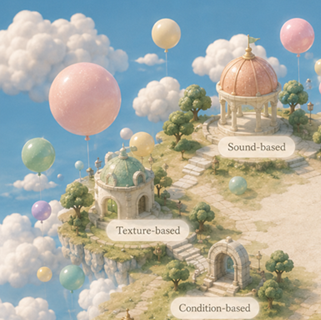
What Is a “Hard Crunch / Scraping” Moment?
It’s when:
- Someone crunches ice cubes
- A pencil scratches across rough paper
- Something hard is scraped repeatedly
- A surface makes a dry grinding sound
In English, we might say:
- Crunch – Breaking something hard with your teeth
- Scrape – Dragging something rough across a surface
- Scratch – Repeated scraping motion
- Grind – Pressing something hard against another surface
But Japanese turns that rough, repetitive action into a vivid sound.

How Is This Feeling Expressed in Japanese?
Japanese often uses repeating syllables to express strong, repeated sounds or actions.
The standout word for a sharp, dry crunch or scrape is:
“Gari Gari” (がりがり)
It represents a rough, grinding crunch — something hard being scraped or bitten repeatedly.
Let’s hear how it sounds.
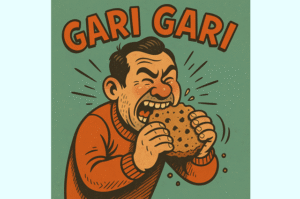
What Is Japanese Onomatopoeia “Gari Gari (がりがり)” ?
“Gari Gari” describes:
Hard Crunching Sounds
- Chewing ice
- Crunching very hard snacks
- Biting into something solid
Rough Scraping Actions
- Scratching a surface
- Pencil scraping across rough paper
- Repeated scraping sounds
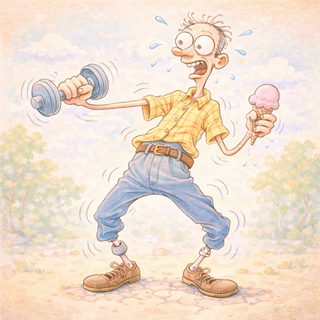
Very Thin Appearance
- A person who is extremely skinny
- Bones showing through the body
It’s a word that connects sound, action, and appearance.
The sound is rough.
The motion is strong.
The image is sharp and thin.
Pronunciation
gah-ree gah-ree
(Emphasize the dry “ga” — it feels sharp and repetitive.)
Categories
Sound / Texture / Condition / Visual
Examples in Daily Life
To learn about how it appears in manga or daily conversation, dive into the following page:
Examples















Comments