
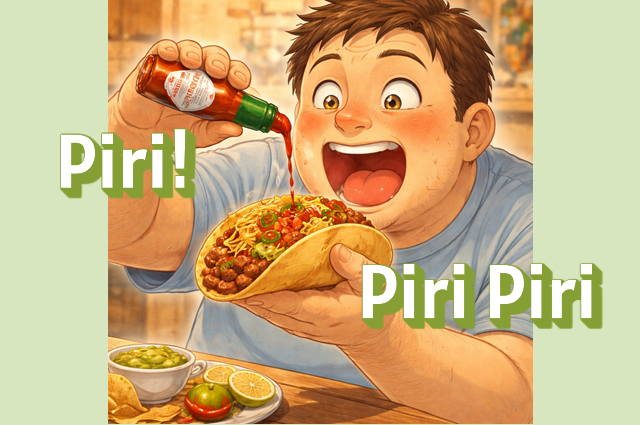
Have you ever felt a sudden sharp sting — like a quick electric shock?
Or a lingering spicy sensation that stays on your tongue?
In Japanese, these two sensations are expressed with very similar sounds:
Piri! (ぴりっ!)
あわせて読みたい

What Is “Piri!”? The Japanese Sound of a Sharp Sting or Spicy Kick
Ever taken a bite of something just a bit too spicy — like wasabi or chili? Or touched something and felt a sudden zap, like static electricity? That’s when …
Piri Piri (ぴりぴり)
あわせて読みたい
What Is “Piri Piri”? The Japanese Sound of Tingling, Stinging Sensation
Have you ever eaten something spicy that lingers on your tongue? Or felt a sharp, tingling sensation on your skin? That continuous, prickly feeling in Japane…
They may sound alike,
but they describe very different experiences.

Table of Contents
Differences Between “Piri” and “Piri Piri”

| Expression | Meaning | Key Feeling |
|---|---|---|
| Piri! (ぴりっ) | A brief, sharp sting | Instant, one-time sensation, Momentary |
| Piri Piri (ぴりぴり) | A continuing tingling sensation | Repeated, ongoing sensation, Continuous |
In short:
- Piri! → a quick, single shock
- Piri piri → a lingering, repeated sensation
Examples in Daily Life
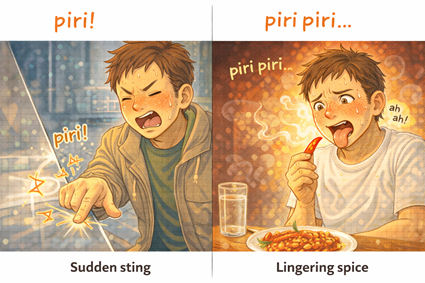
Example 1: Sudden sting (Piri!)
He touched the metal surface —
a small shock ran through him —
piri!
Example 2: Lingering spice (Piri Piri)
After eating the chili,
his tongue kept tingling —
piri piri…
Try Using Them!
Feeling a quick, sharp sting? → Say piri!
Feeling a lingering, repeated刺激? → Say piri piri
Two nearly identical sounds —
but completely different timing!
More Condition-based Onomatopoeia:









Comments