
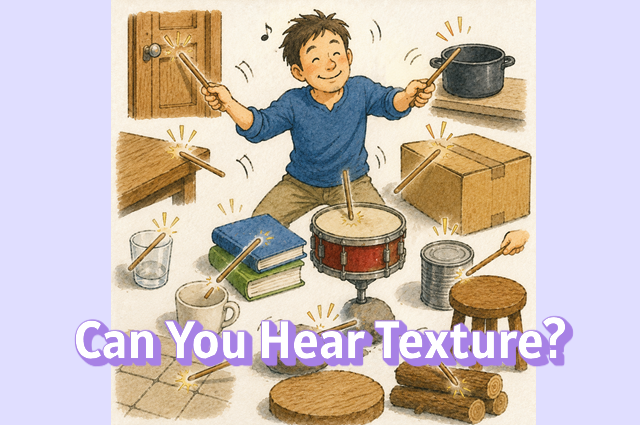
Have you ever wondered what a stone sounds like?
Or a hand gently knocking on a wooden door?
In Japanese, the sound of two things touching can sometimes tell us much more than simply “something hit something.”
It can suggest whether the objects are hard or soft.
Whether the contact is light or heavy.
Even whether the movement feels sharp, gentle, rhythmic, or forceful.
From the perspective of Puni Puni Dictionary, Japanese onomatopoeia sometimes seems to turn sound into texture.

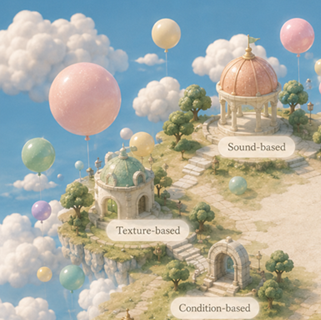
Kachi Kachi vs. Ton Ton — Can You Hear the Difference?
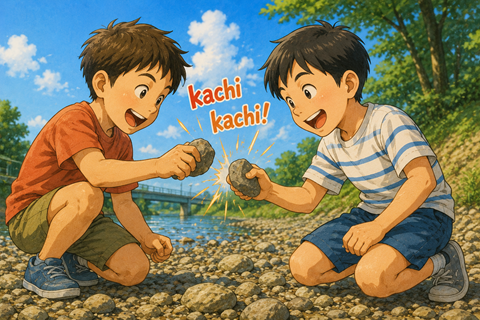
Imagine two stones being tapped together.
Kachi kachi (かちかち).
The sound feels hard, dry, and crisp.
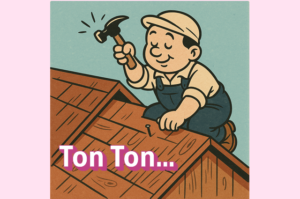
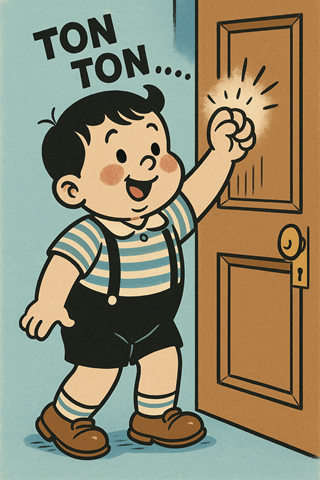
Now imagine someone gently knocking on a wooden door.
Ton ton (とんとん).
This time, the sound feels lighter and softer.
Both expressions describe repeated contact.
But they do not create the same physical image.
With kachi kachi, you can almost feel the hardness of the objects.
With ton ton, you can almost feel the gentle movement of the hand.
The sound seems to carry information about touch.

One Action, Many Different Sounds
In English, we might use words such as:
- tap
- knock
- hit
- bump
Japanese has ordinary verbs for these actions too.
But onomatopoeia can add another layer.
Compare these impressions:
Kon Kon (こんこん)
A relatively light knocking sound against a hard surface.
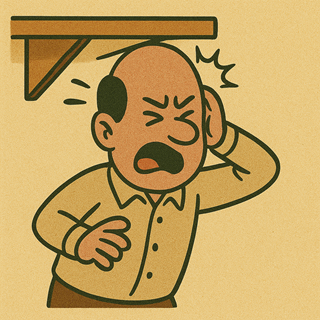
Gon! (ごん!)
A heavier, stronger impact — something solid hitting something else.
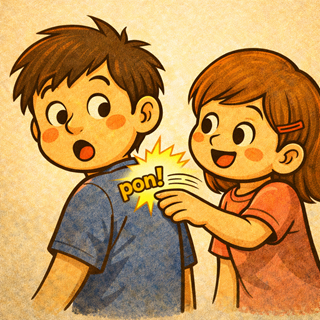
Pon! (ぽん!)
Light, springy taps that often feel softer and more cheerful.
These expressions do not simply tell us that contact happened.
They can suggest what that contact felt like.
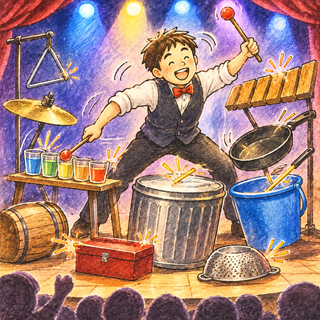
Sound Can Suggest Hardness
This is where Japanese onomatopoeia becomes especially interesting.
Consider:
kachi
gon
pon
ton
Even without seeing the objects, Japanese speakers may form different impressions from these sounds.
Some feel hard.
Some feel heavy.
Some feel light.
Some almost seem to bounce.
Of course, these impressions are not strict scientific rules, and context can change how an expression is understood.
But there seems to be a fascinating relationship between the sound of the word and the physical quality of the scene it describes.
Sound, Weight, Force, and Touch
Perhaps we can imagine these expressions as carrying several kinds of information at once:
Hardness
Does the contact sound hard and sharp?
Weight
Does the impact feel light or heavy?
Force
Is something touching gently or striking strongly?
Rhythm
Does it happen once, or repeatedly?
Texture
Does the scene somehow feel hard, soft, crisp, or springy?
A tiny sound expression can sometimes suggest several of these qualities simultaneously.
That may be one reason Japanese onomatopoeia can make a scene feel so vivid.
Are We Really “Hearing” Texture?
Not literally, of course.
But language can make our senses overlap in interesting ways.
When we hear kachi kachi, we may imagine hard surfaces.
When we hear pon pon, we may imagine something lighter and softer.
The sound leads to an image.
And the image can lead to an imagined physical sensation.
In that sense, Japanese onomatopoeia sometimes seems to create a small bridge:
Sound → Image → Touch
We hear the word — and somehow, we can almost feel the scene.
A Tiny Sound-Based Texture Map
From the perspective of Puni Puni Dictionary, Japanese onomatopoeia can sometimes feel like a tiny sound-based texture map.
Not a fixed system.
Not a dictionary of strict sound rules.
But a collection of subtle clues.
Kachi kachi may lead us toward hardness.
Ton ton toward gentle tapping.
Gon toward weight and impact.
Pon toward lightness and bounce.
Each expression gives the imagination a slightly different physical world.
The World Is Not Just Seen — It Is Felt
Japanese onomatopoeia is often introduced simply as “sound words.”
But perhaps that description is too small.
Some expressions imitate sounds.
Some describe movement.
Some describe emotions.
And some seem to let us hear qualities that are normally understood through touch.
Hardness.
Weight.
Force.
Softness.
Bounce.
Perhaps Japanese onomatopoeia does not simply imitate the sounds of the world.
Sometimes, it lets us hear what the world feels like.






Comments