
When you think of Japanese onomatopoeia, what comes to mind?
Perhaps words like wan wan for a dog barking, fuwa fuwa for something soft and fluffy, or waku waku for excitement.
Onomatopoeia can sound playful, casual, and sometimes even childlike.
So you might assume that it belongs mainly in casual conversation — not in the workplace.
But that isn’t necessarily true.
Japanese speakers also use onomatopoeia in business conversations.
And sometimes, it can be surprisingly effective.
“Going Smoothly” or “Saku Saku”?
Imagine someone giving an update on a project.
作業は順調に進んでいます。
The work is progressing smoothly.
Now compare it with:
作業がさくさく進んでいます。
The work is moving along saku saku.
The basic message is similar.
But saku saku adds something more.


Originally, saku saku can describe a light, crisp texture — like biting into something pleasantly crunchy.
When it describes work, however, you can almost feel tasks being completed one after another, quickly and smoothly, without getting stuck.
Now consider another example:
業績は着実に伸びています。
Business performance is steadily improving.
And:
業績がぐんぐん伸びています。
Business performance is growing gun gun.
Gun gun gives the growth energy.


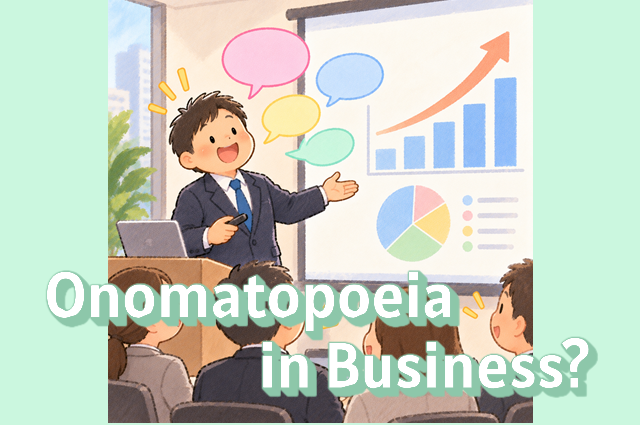
Instead of simply understanding that the numbers are going up, you can almost picture a graph rising strongly and rapidly.
The information has become an experience.
Pulling the Listener Into the Feeling
Perhaps this is one reason onomatopoeia can be so effective even in business communication.
It doesn’t simply tell us what is happening.
It can also help us feel how it is happening.
Speed. Momentum. Rhythm. Energy.
A well-chosen onomatopoeia can communicate all of these almost instantly.
In that sense, Japanese onomatopoeia can sometimes work as a small but powerful tool for engagement.

It pulls the listener into the speaker’s perception of what is happening.
Of course, that doesn’t mean onomatopoeia belongs in every formal report, presentation, or business document.
But in meetings, presentations, and conversations with colleagues, it can be an effective communication technique.
Japanese onomatopoeia isn’t simply cute or casual language.
Sometimes, it is a way of turning information into something the listener can almost feel.









Comments