
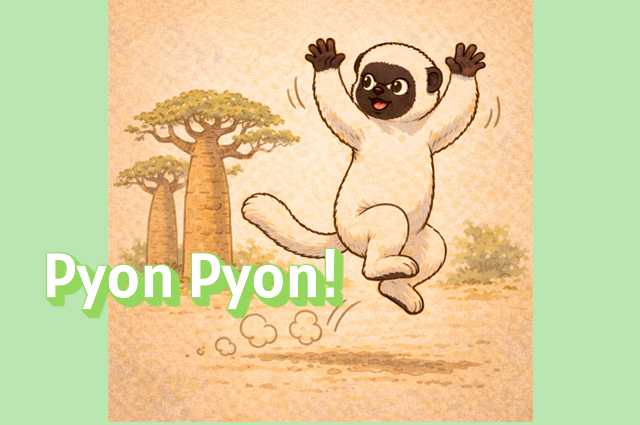
Some movements don’t just move — they bounce.
They’re light, quick, and full of energy.
Not a heavy leap. Not a serious jump.
Just a playful little lift off the ground.
English gives us words like “hop,” “bounce,” or “skip.”
But what if there were a word that sounded exactly like that cheerful motion?
What Is a “Happy Hop” Moment?
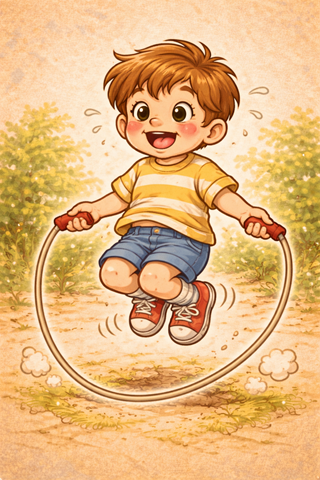
It’s not a heavy jump.
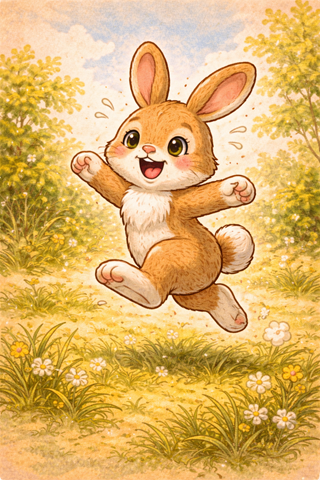
It’s light. Springy. Playful.
In anime and manga, this happens when:
- a rabbit hops across a meadow
- a child jumps up and down after hearing good news
- a character bounces excitedly before running off
- someone moves with extra pep and rhythm
In English, these moments are described as:
- Hop – A small, light jump
- Bounce – A springy upward movement
- Skip – A cheerful, rhythmic step
- Leap (lightly) – A playful jump
But none of these fully express the texture, emotion, and rhythm of the moment.
If You Had to Say It in One Word… Try “Pyon Pyon”
In Japanese, there’s a delightful onomatopoeic expression that captures this playful bounce perfectly:
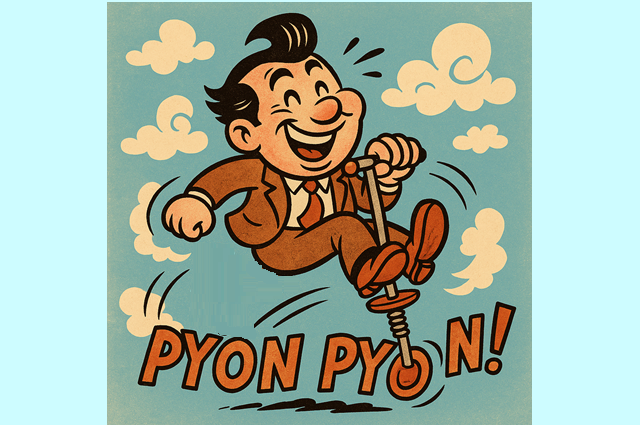
pyon pyon (ぴょんぴょん) — the light, happy motion of hopping again and again.
It’s one of the many magical sound-based expressions in Japanese known as onomatopoeia,
where the rhythm of the word mirrors the rhythm of the movement.
The repeated sound — pyon pyon — reflects that repeated bounce.
With “pyon pyon,” you can describe animals, children, excited characters —
anyone moving with joyful energy.
It’s cute. It’s lively. It practically hops when you say it.
Wouldn’t it be fun to borrow this expression in English too?
Next time you whisper something, try saying this word —
it’s fun and feels just right.
What Does “Pyon Pyon” Really Mean?
Want to learn more about its pronunciation, nuance, and how it appears in manga, children’s books, and daily conversation?
Dive into the following page ↓↓↓






Comments