
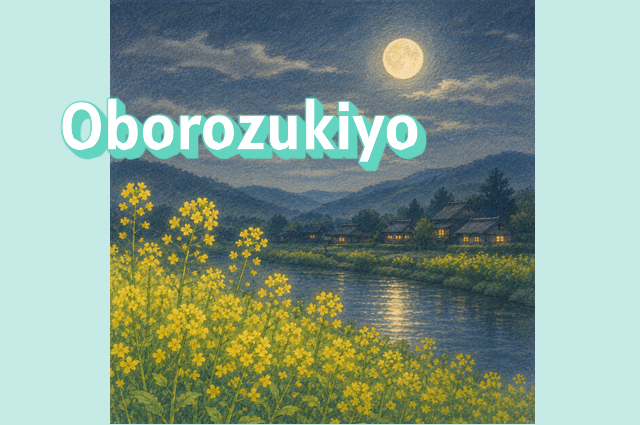
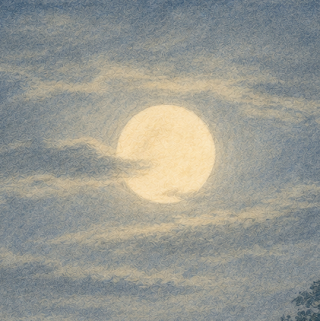
A moonlit night with a slightly hazy moon.
That is one way to describe oborozukiyo (おぼろづきよ/朧月夜).
But that definition alone does not fully explain the word.
After all, hazy moons can be seen in many places around the world.
Why did Japanese people think this moment was important enough to give it a name?
A Word That Means More Than Its Definition
The word oborozukiyo is made up of:
- oboro (おぼろ/朧) — hazy, indistinct, softly blurred
- zuki (づき/月) — moon
- yo (よ/夜) — night
Literally, it means “a hazy moonlit night.”
However, Japanese people do not simply imagine a blurry moon when they hear this word.
The word often evokes an entire atmosphere:
- a quiet spring evening
- soft moonlight filtering through a light haze
- gentle air that is neither cold nor hot
- a feeling of calmness and mystery
In that sense, oborozukiyo is not just about what we see.
It is about the mood of the night itself.
The Onomatopoeic Feelings Hidden Inside
Oborozukiyo is not an onomatopoeia.
Yet it can be understood through onomatopoeic feelings.
Bonyari (ぼんやり)
The moon’s outline appears soft and unclear.

Yura Yura (ゆらゆら)
The moonlight seems to drift gently through the haze.

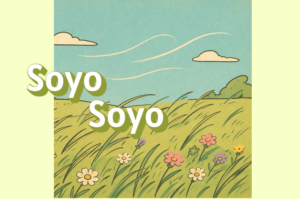
Soyo Soyo (そよそよ)
A light spring breeze moves quietly through the night.
Shiiin… (しーん)
The surrounding world feels peaceful and still.

Together, these feelings create the atmosphere hidden inside the word oborozukiyo.
The Beauty of Not Seeing Clearly
Many cultures value clarity.
A bright sky.
A sharp outline.
A perfect view.
Yet oborozukiyo suggests something different.
The moon is beautiful not despite the haze, but partly because of it.
The soft blur creates mystery.
It leaves room for imagination.
Instead of revealing everything, the night invites us to wonder.
Perhaps this is one reason why the word has remained beloved in Japanese culture.
More Than a Moon
When Japanese people hear oborozukiyo, they often imagine more than the moon itself.
They may imagine:
- the arrival of spring
- a peaceful evening walk
- distant mountains fading into darkness
- quiet moments of reflection
The word contains an entire scene.
The moon is simply the center of it.
Why Did Japanese People Give This Moment a Name?
The moon changes every night.
The weather changes every night.
And the delicate conditions that create an oborozukiyo do not happen all the time.
Perhaps this is why people noticed it.
Not because it was dramatic.
But because it was subtle.
Not because it demanded attention.
But because it quietly rewarded those who paid attention.
What Does Oborozukiyo Tell Us About Japan?
Many Japanese words describe moments that are easy to overlook:
- komorebi
- hanafubuki
- oborozukiyo
- samidare
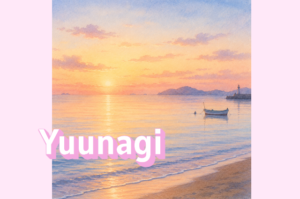
- yuunagi
These words often focus on small changes in nature.
They encourage us to slow down and notice what is already around us.
In that sense, oborozukiyo is more than a word.
It is a reminder that beauty does not always need to be bright or obvious.
Sometimes it can be found in things that are soft, quiet, and slightly unclear.
Final Thought
Oborozukiyo means a hazy moonlit night.
But that is only the beginning.
The real meaning may be found in the feelings hidden inside the scene:
bonyari…
yura yura…
soyo soyo…
shiiin…
Perhaps that is why Japanese people thought this moment was important enough to give it a name.








Comments