
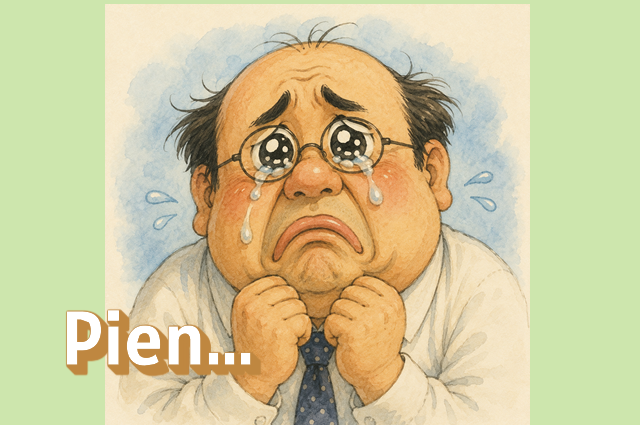
Have you ever wanted to say, “I’m about to cry,” but in a cute and playful way?
Many Japanese people today simply say:
“Pien” (ぴえん)
Although it isn’t a traditional Japanese onomatopoeia, it feels remarkably similar.
Let’s hear how it sounds!
What is “Pien” (ぴえん)?
“Pien” is a modern Japanese expression used to show:
- Feeling about to cry
- Mild sadness or disappointment
- Cute, exaggerated frustration
It is often used humorously, especially in casual conversations and on social media.

Pronunciation
pee-en
(Say it softly, like you’re holding back tears.)
Category
Emotion
Related Emoji
🥺
😭
Related Japanese Kaomoji
(。•́︿•̀。)
(;ω;)
Related Western Smiley
🙁
:'(
What Does “Pien” Look Like?
It looks like someone puffing out their cheeks after a small disappointment.
Eyes becoming watery after hearing bad news.
A playful “I’m going to cry…” face rather than real sorrow.

How Do You Say It?
Say it with a tiny pout:
Pien…
Like you’re pretending to cry just a little.
Example in Daily Life
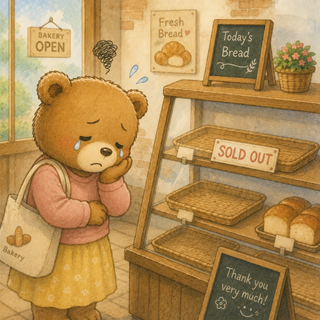
Example: Sold out!
She arrived at the bakery just a little too late, and her favorite bread was already sold out —
pien…
She laughed at herself and promised to come earlier next time.
Cultural Note
“Pien” is not a traditional Japanese onomatopoeia.
Instead, it belongs to what we call Almost Onomatopoeia—expressions that aren’t true onomatopoeia but feel very similar.
Like many Japanese onomatopoeic words, “pien” captures an emotion with a simple sound rather than a full sentence.
Its popularity grew through social media and internet culture, where people began using it to express small disappointments in a humorous, lighthearted way.
It suggests:
Playful sadness
Cute disappointment
Lighthearted frustration
Watch & Feel the “Pien” World!
Feel the “Pien” — Mild Sadness

Try Using It!
When something doesn’t go quite your way…
When you’re a little disappointed but can still smile…
When you’re jokingly “about to cry”…
Say it playfully:
Pien…
Sometimes a tiny sound can say more than a whole sentence.










Comments