
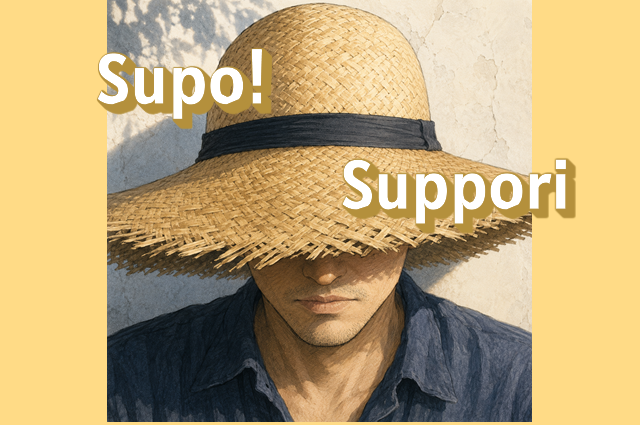
Have you ever put on a hat in one smooth motion?
Then noticed how comfortably it covered your head afterward?
Japanese uses two closely related expressions for these moments:
Supo! (すぽっ!)
あわせて読みたい

What Is “Supo!”? The Japanese Sound of Something Slipping Perfectly Into Place
Have you ever dropped the last puzzle piece into the box? Or watched a cork come out of a bottle with a satisfying pop? That quick, satisfying moment in Japa…
Suppori (すっぽり)
あわせて読みたい
What Is “Suppori”? The Japanese Feeling of Being Completely Covered or Inside
Have you ever wrapped yourself completely in a warm blanket? Or found an object that fit entirely inside a box? That comfortable feeling in Japanese is expre…
Both describe things fitting neatly, but one focuses on the moment, while the other describes the result.

Table of Contents
Differences Between “Supo!” and “Suppori”
| Expression | Focus | Nuance |
|---|---|---|
| Supo! | The moment of movement | Something slips neatly into or out of place |
| Suppori | The final state | Something is completely inside or fully covered |
In short:
- Supo! → the satisfying moment something slips into place
- Suppori → the comfortable feeling after it’s completely inside
Examples in Daily Life
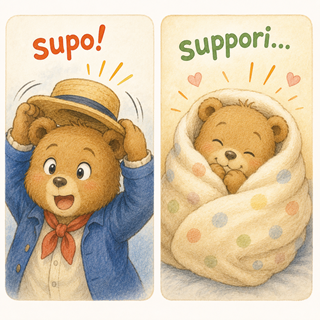
Example 1: Putting on a hat (Supo!)
He placed his hat on his head in one quick motion —
supo!
Example 2: Wrapped in a blanket (Suppori)
The baby was completely wrapped in a soft blanket —
suppori…
Try Using Them!
Something slips neatly into place?
→ Say supo!
Something is completely inside or comfortably covered?
→ Say suppori
Supo! captures the movement.
Suppori describes the finished result.
One lasts a moment.
The other lasts as long as the comfortable fit remains.
Two similar sounds—one exciting moment and one cozy result.
Explore More: Comparison Series








Comments