
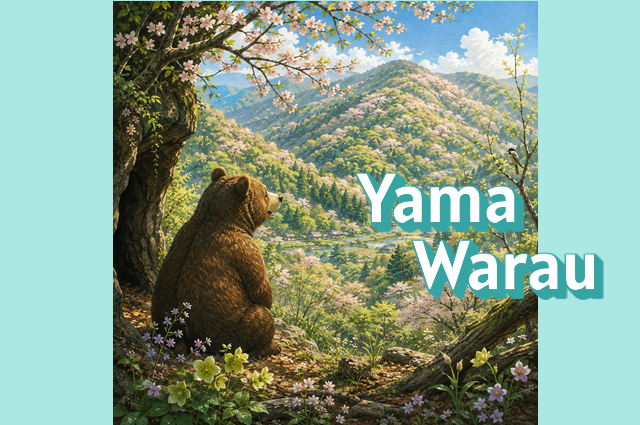
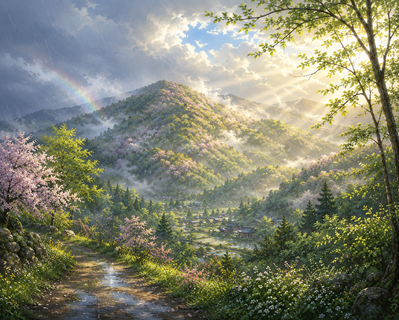
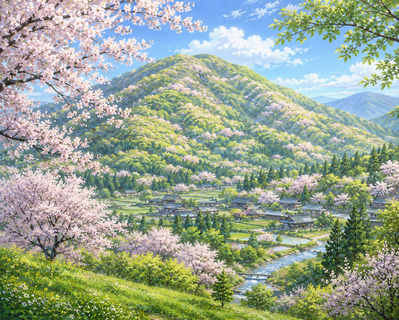
Mountains covered with fresh greenery in spring.
That is one way to describe yamawarau (やまわらう / 山笑う).
But that definition alone does not fully explain the word.
After all, mountains exist everywhere in the world.
So why did Japanese people describe them as “smiling”?
A Word That Means More Than Its Definition
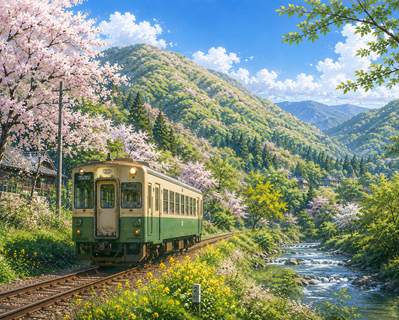
The expression yamawarau literally means “the mountains smile.”
Of course, mountains cannot actually smile.
Instead, this poetic expression describes the arrival of spring.
After a long winter, fresh leaves begin to appear across the mountains.
The landscape changes almost day by day, becoming brighter, greener, and full of life.
When Japanese people hear the words yamawarau, they do not simply imagine green mountains.
They often imagine a mountain that has awakened.
A mountain that feels alive once again.
In that sense, yamawarau is not just about nature.
It is about the joyful return of life.
The Onomatopoeic Feelings Hidden Inside
Yamawarau is not an onomatopoeia.
Yet it can be understood through onomatopoeic feelings.
Gun Gun (ぐんぐん)
Fresh plants and young leaves grow with remarkable energy.

Ao Ao (あおあお)
The mountains become richly covered in vibrant spring greenery.

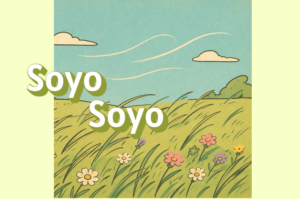
Soyo Soyo (そよそよ)
A gentle spring breeze moves softly through the trees.
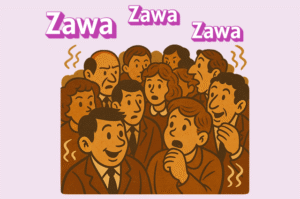
Zawa Zawa (ざわざわ)
Leaves rustle as the forest comes alive.
Waku Waku (わくわく)
The lively mountains make people feel excited to go outside and experience spring for themselves.

These words are not part of yamawarau itself.
But together they help create the feeling hidden inside the expression.
Why Did Japanese People Describe Mountains as Smiling?

Mountains do not smile.
Yet spring can transform them so completely that they almost seem to.
Instead of simply noticing that the leaves have turned green, Japanese people imagined the mountain itself becoming cheerful and full of life.
The interesting question is not:
“What does yamawarau mean?”
The interesting question is:
“Why did Japanese people think a mountain could smile?”
Perhaps it reflects a tendency to see nature as something living rather than something separate from ourselves.
Or perhaps spring simply brings so much life that “smiling” becomes the most natural way to describe it.
There is no single answer.
But the expression itself tells us something about how Japanese people have looked at the natural world.
What Does Yamawarau Tell Us About Japan?
Many Japanese words describe more than what we can see.
They express the feeling of a season.
Words such as:
- komorebi (sunlight filtering through leaves)
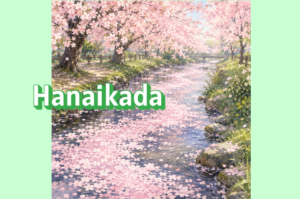
- hanafubuki (a storm of cherry blossom petals)
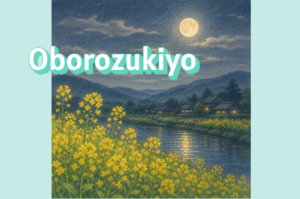
- oborozukiyo (a hazy moonlit night)
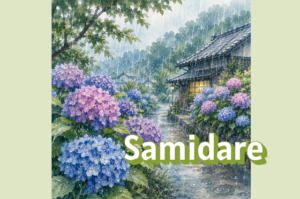
- samidare (early summer rain)
- yamawarau (mountains smiling with fresh spring greenery)
These expressions do more than describe nature.
They invite us to experience it.
In that sense, yamawarau is more than a poetic phrase.
It is a small window into how Japanese people celebrate the arrival of spring.
Final Thought
Yamawarau describes mountains covered with fresh spring greenery.
But that is only the beginning.
The real meaning may be found in the feelings hidden inside the season:
gun gun…
ao ao…
soyo soyo…
zawa zawa…
waku waku…
Perhaps that is why Japanese people imagined the mountains themselves smiling.







Comments