
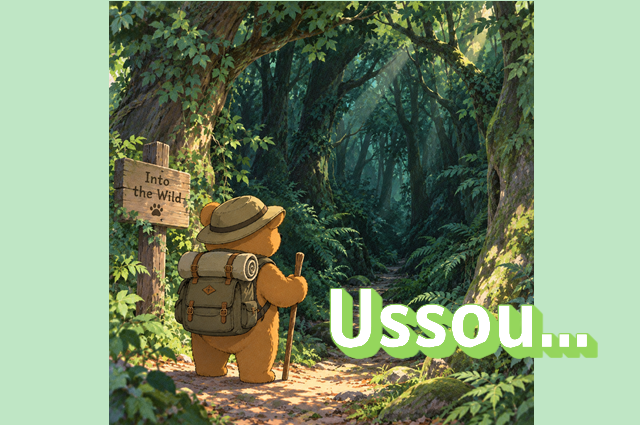
Imagine standing at the edge of a forest.
Trees rise close together.
Branches overlap.
Leaves fill the spaces between them.
You look toward the forest floor, but the farther you look, the darker it becomes.
In Japanese, we might describe such a place as:
ussou to shita mori (うっそう と した もり / 鬱蒼とした森)
—a dense, thickly overgrown forest.
What Makes a Forest Feel Usssou?
This time, perhaps we need only two expressions.
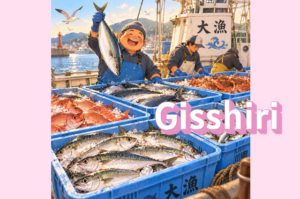
Gisshiri (ぎっしり) — Packed with Green
Gisshiri
Trees.
Branches.
Leaves.
More leaves behind them.
And still more beyond those.
“Gisshiri” describes things packed closely together, with little empty space between them.
In an ussou forest, vegetation does not feel scattered or sparse.
It fills the space.
Look between two trees, and there is another tree.
Look through the leaves, and there are more leaves.
The forest feels almost physically dense.
Kuro Guro (くろぐろ) — Darkness Beyond the Leaves
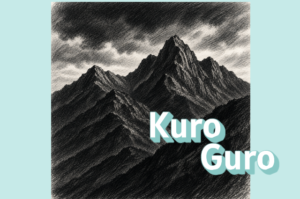
Kuro guro
All that vegetation does something else.
It blocks the light.
Near the edge of the forest, individual leaves may still shine in the sun.
But deeper inside, the green gradually gives way to shadow.
Kuro guro expresses something appearing deeply, intensely black.
In an ussou forest, it can evoke the dark mass of vegetation — and the shadowy space beyond it.
You can see the forest.
But you cannot quite see through it.
When Density Creates Darkness
This is what makes ussō interesting.
Gisshiri and kuro guro are not simply two unrelated impressions.
One can create the other.
The trees and leaves grow gisshiri—
so the light cannot easily enter.
And the forest begins to look kuro guro.
Density becomes darkness.
The physical structure of the forest creates its atmosphere.
Perhaps that is why ussō can feel so much stronger than simply saying that there are “many trees.”
It gives us a sense of depth.
Of thickness.
Of a place whose interior is partly hidden from us.
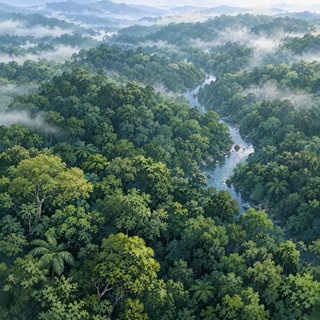
A Forest You Cannot See Through
An open grove lets your eyes travel between the trees.
An ussou forest stops them.
There is always something in the way:
another branch,
another layer of leaves,
another dark trunk.
That visual barrier changes how the forest feels.
It can seem mysterious.
Quiet.
Perhaps even slightly intimidating.
Not because ussō itself means any of those things—
but because we cannot easily see what lies beyond the dense vegetation.
Final Thought
Gisshiri.
The forest fills with trees, branches, and leaves.
Kuro guro.
Beyond them, the light begins to disappear.
Only two expressions.
But perhaps that is enough.
Because together, they give us the two sensations at the heart of ussō:
density and darkness.
And somewhere between the two,
a forest becomes more than simply thick with trees.
It becomes a place we cannot quite see through.
Ussou.


Comments