
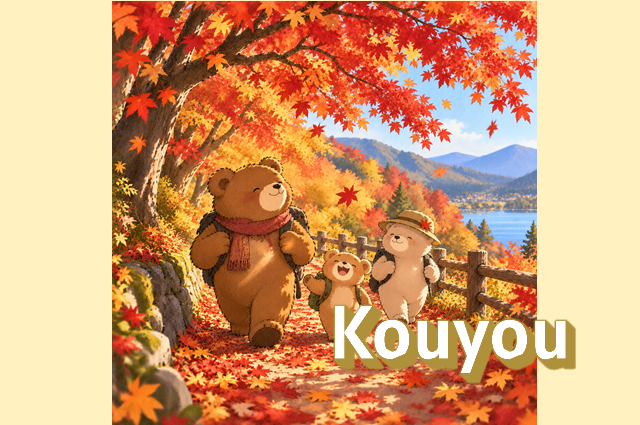
When autumn arrives in Japan, mountains, parks, temple gardens, and city streets begin to change color.
Leaves turn red, orange, and gold.
But “Kouyou” (こうよう / 紅葉) is more than a change of color.
It is also a scene that moves.
Leaves fall quietly from the trees.
Dry leaves gather beneath our feet.
And as we walk through them, autumn has a sound.
What does “Kouyou” (こうよう) feel like?
Perhaps three Japanese onomatopoeic expressions can help us step inside the scene.
Aka Aka (あかあか) — The Vivid Red
Aka aka…
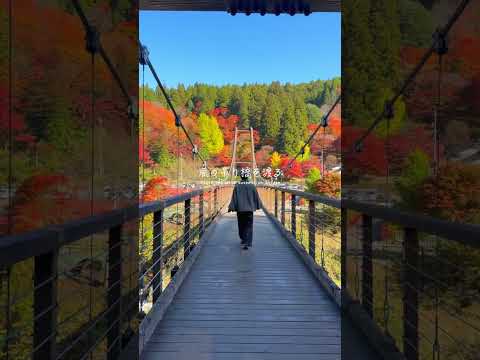
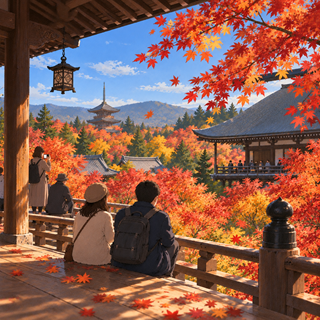
Red leaves glow against the autumn sky.
“Aka aka” expresses a vivid, striking redness — a color that seems rich and intense.
When we think of Kouyou, this brilliant red is often one of the first things we see.
It is autumn announcing itself through color.
Hara Hara (はらはら) — Leaves Falling One by One
Hara hara…
A leaf lets go of a branch.
Then another.
They drift downward, one after another.
“Hara hara” can describe small, light things falling gently and continuously.
With kōyō, it captures a beautiful part of the season that a photograph cannot quite hold:
the leaves are not only colorful.
They are already beginning to fall.

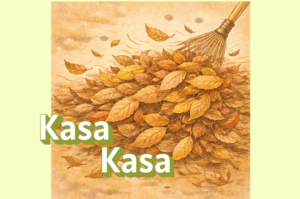
Kasa Kasa (かさかさ) — Autumn Beneath Our Feet
Kasa kasa…
By the time we go out to enjoy the autumn colors, some of the leaves are no longer on the trees.
They are under our feet.
Dry leaves rustle as we walk through them.
“Kasa kasa” expresses that dry, light sound — and also the dry texture of the leaves themselves.
So kōyō is not only something we see above us.
We can hear it beneath our feet.
A Beauty That Is Already Changing
Spring greenery can feel fresh, soft, and full of new life.
Kōyō has a different kind of beauty.
The colors may be at their most brilliant just as the leaves are drying and beginning to fall.
Aka aka…
Hara hara…
Kasa kasa…
Color, movement, and sound are happening together.
Perhaps that is part of what makes autumn leaves so moving.
Their beauty does not stay still.
Final Thought
Aka aka gives us the color.
Hara hara gives us the falling leaves.
Kasa kasa gives us the dry sound beneath our feet.
None of these expressions means “kōyō.”
But together, they bring us into an autumn landscape.
Look up:
Aka aka…
Watch the leaves:
Hara hara…
Take a few steps:
Kasa kasa…
And suddenly, kōyō is no longer simply “autumn leaves.”
It is something we can see, hear, and feel.



Comments