
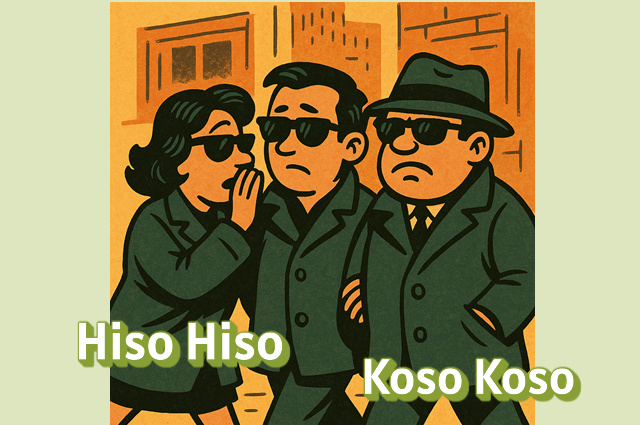
Ever overheard a secret being whispered in a corner?
Or noticed someone sneaking around trying not to be seen?
In Japanese, these sounds and actions are captured perfectly:
Hiso Hiso (ひそひそ)
Koso Koso (こそこそ)

What is “Hiso Hiso” (ひそひそ)?
Soft whispering.
Used for:
- Quiet, secretive conversations
- Whispering so others don’t hear
- Speaking in hushed tones, often with a hint of secrecy
Nuance:
- Quiet voice
- Hidden communication
- Sometimes playful, sometimes suspicious
Example:
They leaned in and whispered to each other —
hisohiso…
Pronunciation
hee-soh hee-soh
(short, rhythmic and breathy)

What is “Koso Koso” (こそこそ)?
Sneaky movement.
Used for:
- Moving quietly so no one notices
- Doing something in secret or behind someone’s back
- Acting suspiciously
Nuance:
- Stealthy or sneaky
- Secretive movement
- Sometimes implies guilt or mischief
Example:
He tiptoed out of the room, trying not to be seen —
koso koso…
Pronunciation
ko-so ko-so
(short, soft repetition — like quick, quiet steps)

Cultural Note
In English, you might say:
- “Whisper” vs “Sneak”
- “Talk in hushed voices” vs “Move secretly”
But in Japanese, these expressions carry sound and emotional texture:
| Expression | Focus | What it Describes | Common Feel |
|---|---|---|---|
| Hiso Hiso | Voice / Speech | Quiet, private talking | Mysterious, gentle |
| Koso Koso | Movement | Sneaky, secretive action | Suspicious, guilty |
That’s why in anime and manga, you’ll often see:
- ひそひそ in speech bubbles with tiny fonts
- こそこそ used in narration when someone moves like a thief!
Examples in Daily Life

Example 1: Whispering in class (Hiso Hiso)
They giggled and whispered behind the teacher’s back —
hiso hiso…
Example 2: Sneaking for midnight snack (Koso Koso)
He tiptoed to the fridge at midnight —
koso koso…
Try Using Them!
Someone whispering in the library? → Say hiso hiso…
Someone sneaking out of a room? → Say koso koso…












Comments