
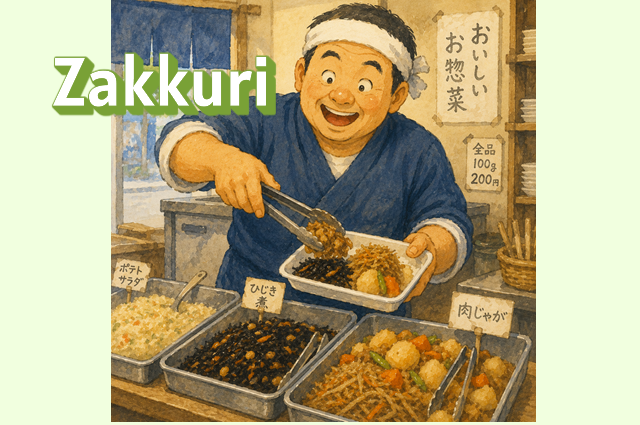
Have you ever cut something boldly in large chunks?
Or explained something in a rough, simplified way?
That feeling of doing something broadly and without fine detail in Japanese is expressed as:
“Zakkuri” (ざっくり)
Let’s hear how it sounds!
What is “Zakkuri” (ざっくり)?
“Zakkuri” is an Almost Onomatopoeia in Japanese.
It originally comes from sounds like:
“zaku” — the sensation of cutting firmly into something.
Today, it is often used to describe:
- Cutting something in large rough pieces
- Explaining something in a broad, simplified way
- Doing something without focusing on fine detail
The core feeling is:
Big divisions rather than precision.
Pronunciation
zahk-koo-ree
(Say it boldly — like making a large cut.)
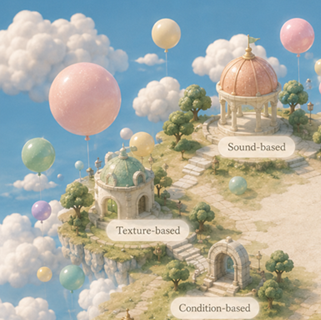
Category
Condition
What Does “Zakkuri” Look Like?
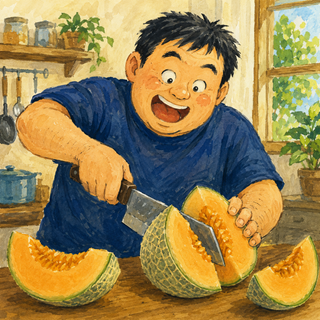
It looks like cutting a melon into large chunks.
Like organizing information roughly instead of precisely.
Like skipping tiny details and focusing on the big picture.

How Do You Say It?
Say it casually and boldly:
Zakkuri.
Like something divided roughly —
clear, but not detailed.
Examples in Daily Life
Example 1: Rough cutting
He cut the melon into large pieces —
zakkuri.
Example 2: Rough explanation
She gave a simple overview —
zakkuri explaining the plan.

Cultural Note
In English, you might say:
- “Roughly”
- “Broadly speaking”
- “In large chunks”
But “zakkuri” has a unique Japanese feeling.
It suggests:
Big, confident divisions
Simplicity over precision
Practical roughness
Unlike purely abstract words,
it still carries a faint physical feeling of:
Cutting
Dividing
Breaking things into manageable pieces
That’s why it still feels connected to sound symbolism.
Watch & Feel the “Zakkuri” World!
Feel the “Zakkuri” — Chinese Knife-cut Noodles
Try Using It!
When you explain something simply…
When you divide things roughly…
When details are less important than the overall picture…
Say it casually:
Zakkuri!











Comments