
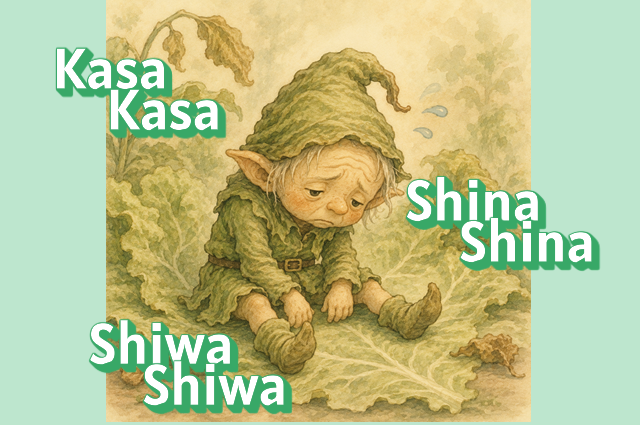
Have you ever forgotten a fresh lettuce in the refrigerator for too long?
As time passes, it can become limp, wrinkled, or dry.
In Japanese, these changes are described with three different expressions:
Shiwa Shiwa (しわしわ)

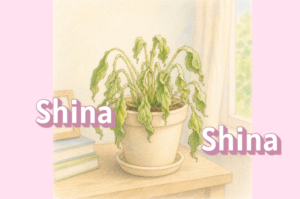
Shina Shina (しなしな)
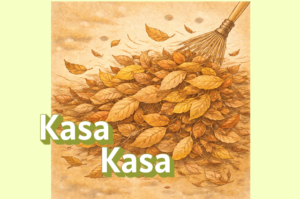
Kasa Kasa (かさかさ)
All three can happen as something loses freshness, but each focuses on a different aspect.
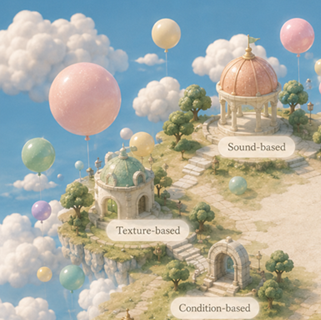
Differences Between “Shiwa Shiwa,” “Shina Shina,” and “Kasa Kasa”
| Expression | Focus | Nuance |
|---|---|---|
| Shiwa Shiwa | Wrinkles and folds | Creased, crumpled |
| Shina Shina | Lost firmness | Wilted, limp |
| Kasa Kasa | Dryness | Dry, rough |
In short:
- Shiwa shiwa → wrinkled
- Shina shina → wilted
- Kasa kasa → dry
Examples in Daily Life
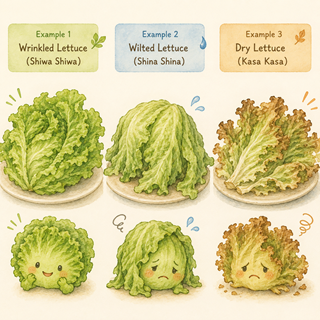
Example 1: Wrinkled lettuce (Shiwa Shiwa)
The old lettuce leaves had many tiny folds and wrinkles —
shiwa shiwa…
Example 2: Wilted lettuce (Shina Shina)
The lettuce had lost its crispness and drooped sadly —
shina shina…
Example 3: Dry lettuce (Kasa Kasa)
The forgotten lettuce had dried out around the edges —
kasa kasa…
A Japanese Perspective
Interestingly, all three expressions can describe the very same lettuce.
Shina shina focuses on how it loses firmness.
Shiwa shiwa focuses on the wrinkles that appear.
Kasa kasa focuses on the loss of moisture.
Japanese often describes not just the object itself, but the particular change people notice.
Try Using Them!
Your lettuce has become limp?
→ Say shina shina
Your lettuce has developed many wrinkles?
→ Say shiwa shiwa
Your lettuce has dried out?
→ Say kasa kasa
One old lettuce.
Three different observations.
Three different Japanese sound words.
That’s one of the charming things about Japanese onomatopoeia!






Comments