

Have you ever heard two hard objects clicking sharply against each other?
Or heard someone gently knocking on a door?
In Japanese, these two kinds of repeated tapping sounds can be expressed as:
Kachi Kachi (かちかち)
あわせて読みたい


What Is “Kachi Kachi”? The Japanese Sound of Hard Clicking and Chattering Teeth
Have you ever heard two hard objects striking together? Or felt your teeth chatter from cold or fear? That hard, repeated clicking sound in Japanese is expre…
Ton Ton (とんとん)
あわせて読みたい
What Is “Ton Ton”? The Soft Sound of a Light Knock or Tap
Ever tapped someone gently on the shoulder to get their attention? Or knocked softly on a door? That’s when the Japanese sound word “Ton Ton” comes in — a ge…
They can both describe repeated contact between objects, but the hardness, strength, and quality of the sound are quite different.
Table of Contents
Differences Between “Kachi Kachi” and “Ton Ton”

| Expression | Meaning | Nuance |
|---|---|---|
| Kachi Kachi (かちかち) | Repeated hard, sharp clicking sounds | Hard, dry, crisp |
| Ton Ton (とんとん) | Repeated light tapping or knocking | Light, gentle, rhythmic |
In short:
- Kachi kachi → hard objects making sharp, crisp sounds
- Ton ton → light, gentle tapping or knocking
あわせて読みたい
Can You Hear Texture? How Japanese Onomatopoeia Makes Hardness and Touch Audible
Have you ever wondered what a stone sounds like? Or a hand gently knocking on a wooden door? In Japanese, the sound of two things touching can sometimes tell…
Examples in Daily Life
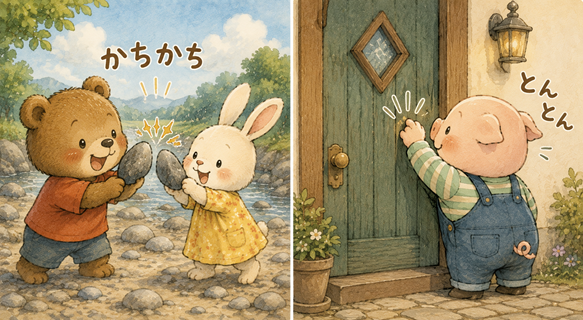
Example 1: Tapping stones together (Kachi Kachi)
The bear and rabbit picked up two hard stones
and tapped them together —
kachi kachi!
Example 2: Knocking gently on a door (Ton Ton)
The little pig stood at the front door
and knocked gently with his hand —
ton ton…
Try Using Them!
Hard objects repeatedly making a sharp, dry sound?
→ Say kachi kachi
Someone lightly tapping or knocking on something?
→ Say ton ton
Both are repeated sounds —
but Japanese lets you hear how hard or gentle the contact feels!
Explore More: Comparison Series








Comments