
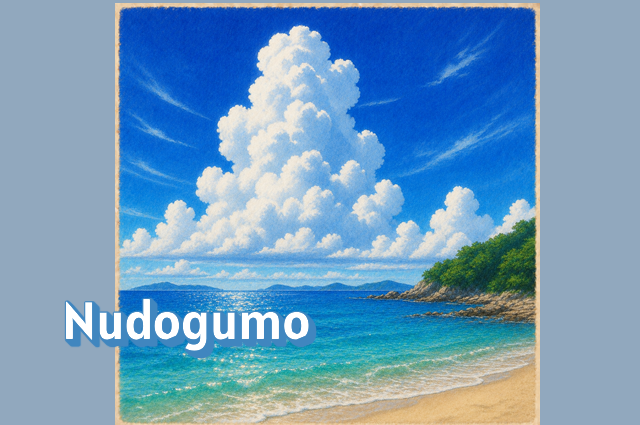
A large, towering thundercloud that grows on hot summer days.
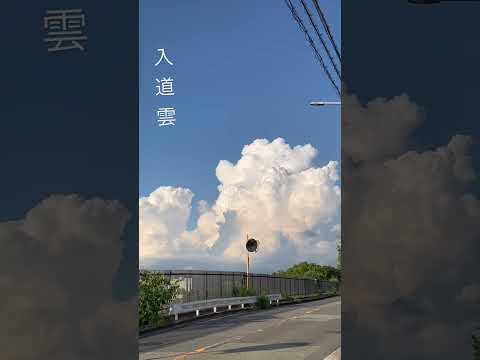
That is one way to describe Nyudogumo (にゅうどうぐも/入道雲).
But that definition alone does not fully explain the word.
Towering clouds appear all over the world.
So why do Japanese people have such a special name for this one?

A Word That Means More Than Its Definition
The word Nyudogumo is made up of:
- nyūdō (にゅうどう / 入道) — a Buddhist monk who has entered religious life
- gumo (ぐも / 雲) — cloud
The cloud was named because its tall, rounded shape reminded people of the shaved head of a Buddhist monk.
But when Japanese people hear the word nyūdōgumo, they rarely think only about its shape.
Instead, they often imagine an entire summer scene:
- a brilliant blue sky
- dazzling sunshine
- the loud chorus of cicadas
- children on summer vacation
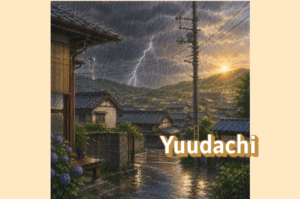
- the possibility of a sudden evening shower
In other words, nyūdōgumo is not simply a cloud.
It is one of the symbols of Japanese summer.
The Onomatopoeic Feelings Hidden Inside
Nyudogumo is not an onomatopoeia.
Yet it can be understood through onomatopoeic feelings.
Moku Moku (もくもく)
The cloud rises higher and higher into the sky.

Ao Ao (あおあお)
The deep blue summer sky stretches endlessly overhead, making the towering white cloud feel even more magnificent.

Gira Gira (ぎらぎら)
The summer sun blazes overhead, making the blue sky and towering white cloud appear even more vivid.

Mīn Mīn (みーんみーん)
Cicadas fill the air with their unmistakable summer song.
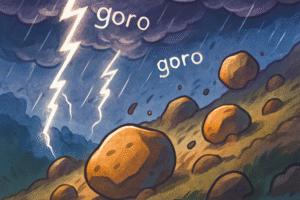
Goro Goro (ごろごろ)
Thunder rumbles inside the growing cloud, hinting that an evening shower may soon arrive.
These words are not part of nyūdōgumo itself.
But together they create the atmosphere hidden inside the word.
Why Did Japanese People Give This Cloud a Name?

Towering thunderclouds exist in many countries.
Yet in Japan, this cloud became much more than a weather phenomenon.
It became a symbol of summer itself.
Perhaps this reflects the strong connection between the Japanese seasons and everyday life.
A single cloud can remind people of school holidays, festivals, hot afternoons, and childhood memories.
The interesting question is not:
“What is a Nyudogumo?”
The interesting question is:
“Why did Japanese people think this cloud was important enough to give it such a memorable name?”
There is no single answer.
But the existence of the word itself tells us that this cloud became part of Japan’s shared memory of summer.
What Does Nyudogumo Tell Us About Japan?
Many Japanese words describe more than objects.
They describe the seasons themselves.
Words such as:
- komorebi (sunlight filtering through leaves)
- hanafubuki (a storm of cherry blossom petals)
- oborozukiyo (a hazy moonlit night)
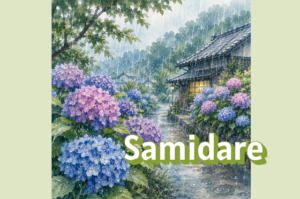
- samidare (early summer rain)
- nyūdōgumo (towering summer clouds)
These words do more than identify what we see.
They preserve the atmosphere surrounding each season.
In that sense, nyudogumo is more than a cloud.
It is a small window into how Japanese people experience summer.
Final Thought
Nyūdōgumo means a towering summer cloud.
But that is only the beginning.
The real meaning may be found in the feelings hidden inside the scene:
moku moku…
Ao Ao…
gira gira…
mīn mīn…
goro goro…
Perhaps that is why Japanese people thought this cloud was important enough to give it a memorable name.











Comments