
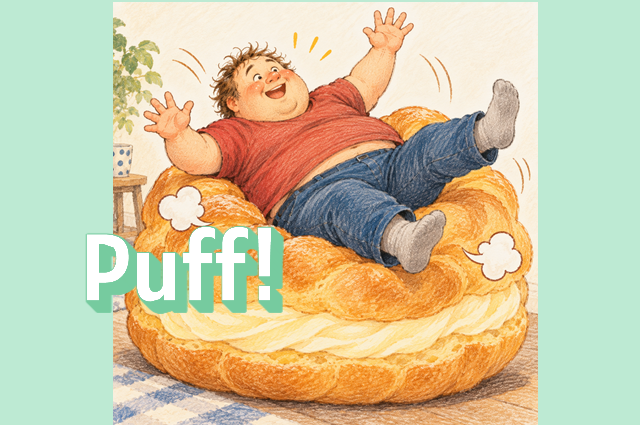
If you are a Japanese speaker, the English word puff may sound strangely familiar.
Puff.
Even before learning its meaning, you might imagine something soft, light, airy, or gently expanding.
Perhaps that is because it sounds a little like Japanese expressions such as ふわっ (fuwa), which can describe something soft, light, or floating.
And the surprising thing is that the meaning of puff seems to fit that feeling remarkably well.
In English, puff can describe a small burst of air or smoke, something swelling or becoming fuller, or something light and fluffy.
Unlike bonbon, which only happens to sound onomatopoeic to Japanese ears, puff itself has an imitative or sound-symbolic history in English. The sound and the sensation seem to have been connected for English speakers, too.

And that raises an interesting question.

Do Speakers of Different Languages Hear Something Similar in Puff?
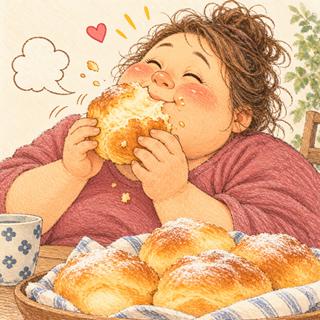
Does the sound itself suggest air, softness, lightness, or expansion, regardless of the language you grew up speaking?
Or does Japanese make puff feel especially “just right” because Japanese speakers are surrounded by words such as ふわっ, ふわふわ, and other expressions that connect sounds with sensations?
Perhaps some connections between sound and meaning cross language boundaries, while others become stronger — or even exist only — because of the language we speak.
There is an interesting clue in the famous bouba–kiki effect. Across different language backgrounds, many people tend to associate a sound like bouba with rounded shapes and kiki with sharp, angular ones.
It suggests that at least some relationships between sound and sensation may reach beyond individual languages.
But how far does that go?
When You Hear “Puff”, What Do You Feel?

Soft? Light? Airy? Expanding?
And if your first language is not Japanese or English, does puff still somehow feel like… puff?
Perhaps every language teaches us its own way of hearing the world — while somewhere underneath, humans may share a few sounds that simply feel right.











Comments