
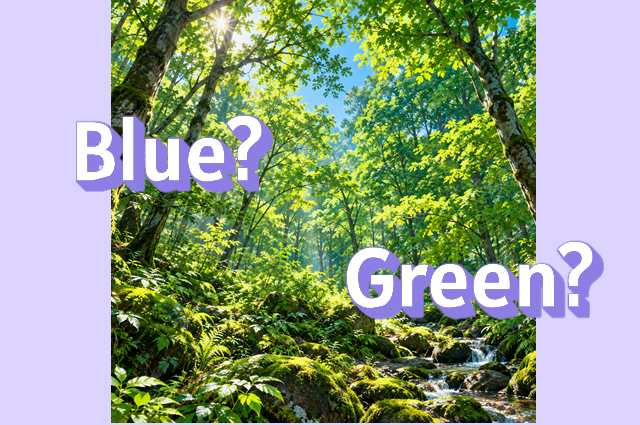
The leaves are fresh, vivid, and unmistakably green.
And yet, a Japanese speaker might say:
木々(きぎ)が青々(あおあお)と茂っている(しげっている)。
Kigi ga ao ao to shigette iru.
“The trees are growing lush and green.”
Wait.
Ao (あお / 青) means blue, doesn’t it?
So why are green leaves described as ao ao (あおあお / 青々)?
Is “Ao” Really Just Blue?
In modern Japanese, ao (あお / 青) usually refers to the color blue—the color of a clear sky or the sea.
But the Japanese word ao has not always matched the modern English category blue so neatly.
Historically, ao covered a broader range of colors and could include shades that today would normally be called midori (緑), green.
Traces of that older way of seeing color still remain in everyday Japanese.
Consider these words:
青菜 (ao na) — green leafy vegetables
青梅 (ao ume) — unripe green plums
青々 (ao ao) — lush, vivid green, especially of plants and trees
None of these things need to be blue.
And yet, they are still ao.
What Does “Ao Ao (あおあお)” Really Describe?
So does ao ao simply mean green?
Not quite.
When Japanese speakers hear 青々とした木々 (ao ao to shita kigi), they do not merely imagine a particular color.
They may picture leaves growing thickly, looking fresh, vivid, and full of life.
There is something almost energetic about ao ao.
It can suggest the rich color of healthy vegetation together with its freshness and vitality.
So ao ao is not simply a color label.
It describes how that green feels.
Where Does Blue End and Green Begin?
This raises a bigger question.
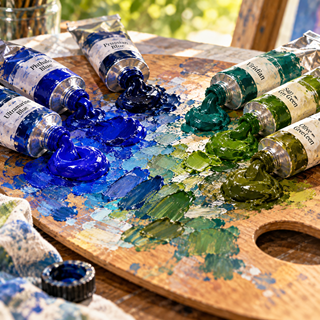
Where exactly does blue end and green begin?
Nature does not draw a line and say:
BLUE | GREEN
Humans draw that line with language.
Colors form a continuous spectrum, but languages divide that spectrum into named categories—and those categories have not always been divided in exactly the same way.
The Japanese word ao gives us a small glimpse of that history.
A color that an English speaker immediately calls green can still carry the linguistic memory of ao in Japanese.
An Older “Ao (あお)” Still Living in Modern Japanese
Today, Japanese speakers do not usually stop to wonder why green trees can be ao ao.
The expression simply feels natural.
山(やま)が青々(あおあお)としている。
Yama ga ao ao to shite iru.
“The mountains are lush and green.”
No one needs to imagine blue mountains.
And perhaps that is what makes ao ao so interesting.
Inside this small expression, an older Japanese way of dividing the world of color is still quietly alive.
The trees in front of us may be green.
But Japanese can still look at them and see—
ao.







Comments