

Here is a Japanese onomatopoeia you have probably never heard before:
mobu mobu.
What does it make you imagine?

Something soft?
Something heavy?
Something moving?
Or perhaps… nothing at all?
There is a good reason you have never heard it.
“Mobu mobu” isn’t actually a Japanese onomatopoeia.
We made it up.
But let’s play with it for a moment.

What Does “Mobu Mobu” Feel Like?
Imagine a handful of soft, fluffy marshmallows.
Now imagine stuffing several of them into your mouth at once.
Your cheeks puff out. Your mouth is completely full. The marshmallows are soft and springy, gently squishing against one another.
Mobu mobu…

Does the sound seem to fit?
Maybe it does.
Maybe it doesn’t.
Keep that feeling in mind.
Another Kind of “Mobu Mobu”
Now let’s change the scene completely.
Imagine standing on an extremely crowded train.
You are surrounded on every side by soft, plump bodies.
From the front, the back, the left, the right…
You are gently but firmly squeezed between them, with nowhere to move.
Mobu mobu, mobu mobu…
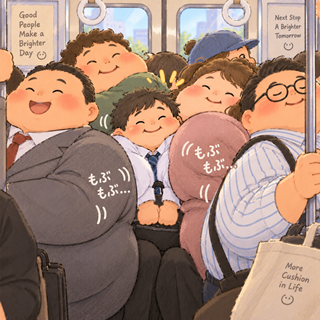
The situation is completely different from a mouth full of marshmallows.
And yet, there seems to be something connecting the two.
Softness.
Thickness.
Springiness.
The feeling of being completely surrounded by something squishy.
Or at least, that is what mobu mobu might suggest to a Japanese speaker.
But why?
A Word That Doesn’t Exist — But Somehow Feels Like It Could
Remember: mobu mobu has no established meaning in Japanese.
We invented it.
And yet, to some Japanese speakers, it may not feel entirely meaningless.
That raises an interesting question.
When we hear a word we have never heard before, are we really hearing it with fresh ears?
Or are all the words and sounds we already know quietly shaping what we imagine?
And there is another question:
If you don’t speak Japanese, did “mobu mobu” give you the same feeling?
In Part 2, we’ll look inside this imaginary word and see what other Japanese onomatopoeia might tell us.












Comments