
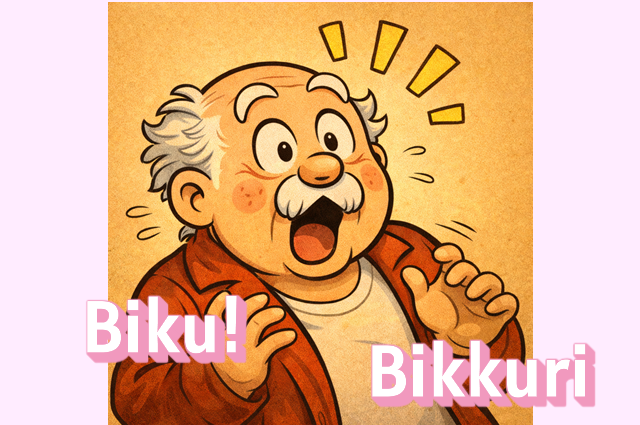
Ever had a sudden physical reaction — like a sharp jolt when something startled you?
Or felt a strong emotional surprise, whether pleasant or shocking?
In Japanese, there are two ways to express these nuances:
Biku (びくっ)
あわせて読みたい


What Is “Biku”? The Japanese Sound of a Sudden Startle or Jolt
Ever been completely absorbed in your thoughts — only to be startled by a loud noise?That brief moment when your body reacts before your brain catches up?Tha…
Bikkuri (びっくり)
あわせて読みたい
What Is “Bikkuri”? The Japanese Sound of Surprise — Almost Onomatopoeia
Ever turned around and suddenly saw someone standing right behind you? Or heard a loud noise that made your heart jump? That’s when the Japanese word “Bikkur…

Table of Contents
Differences Between “Biku” (びくっ) and “Bikkuri” (びっくり)
スクロールできます
| Biku | Bikkuri | |
|---|---|---|
| Type | Onomatopoeia | Almost onomatopoeia |
| Meaning | A sudden small body reaction from surprise | Emotional or cognitive surprise |
| Nuance | Reflexive — flinch, twitch | Broader — feeling surprised |
| Sound | Yes (like a small inner jolt) | No real sound; conceptual |
| Usage | “She flinched — biku!” | “I was really surprised — bikkuri shita.” |
| Verb Compatibility | Usually stands alone or with mimetic verb | Becomes a noun/verb — “bikkuri suru” |
| Tone | More physical / instinctual | More emotional / general-purpose |
Examples in Daily Life
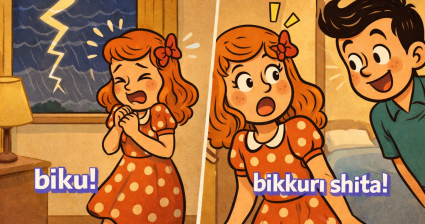
Example 1: Physical surprise (Biku)
She heard the thunder and flinched —
biku!
Example 2: Emotional surprise (Bikkuri)
He appeared out of nowhere —
bikkuri shita!
Try Using Them!
Your shoulder jumps from a sudden sound? → Say biku!
Got news that shocked you? → Say bikkuri!
Explore More: Comparison Series











Comments