
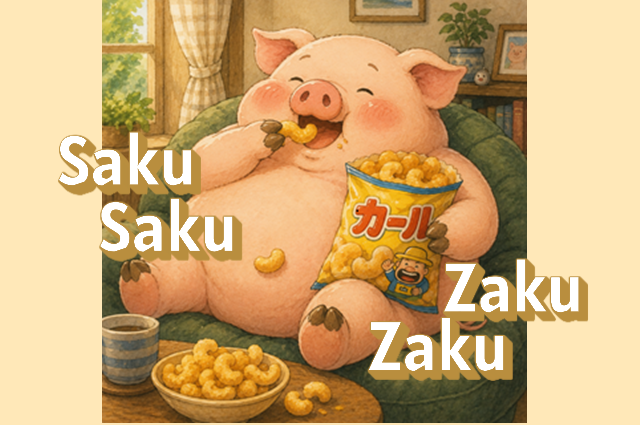
Have you ever bitten into a light, crisp cookie that breaks apart easily?
Or crunched through a thick, chunky cookie with a much rougher texture?
In Japanese, these two kinds of crunchy texture can be expressed as:
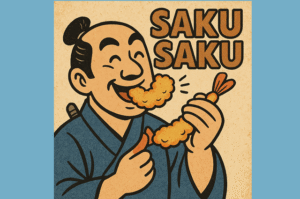
Saku Saku (さくさく)
Zaku Zaku (ざくざく)

They both describe pleasantly crunchy textures, but the lightness, roughness, and strength of the crunch are quite different.

Differences Between “Saku Saku” and “Zaku Zaku”
| Expression | Meaning | Nuance |
|---|---|---|
| Saku Saku (さくさく) | A light, crisp texture that breaks apart easily | Light, delicate, pleasantly crisp |
| Zaku Zaku (ざくざく) | A coarse, substantial crunch | Rough, chunky, strongly crunchy |
In short:
- Saku saku → light and crisp, breaking apart easily
- Zaku zaku → coarse and chunky, with a stronger crunch
Examples in Daily Life
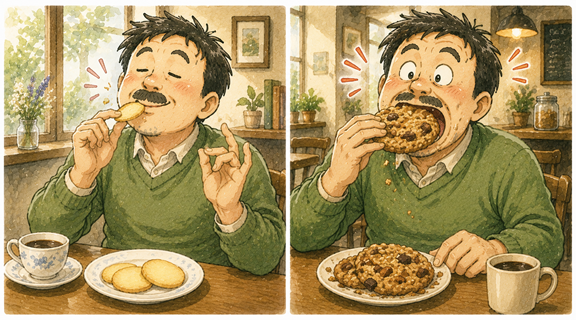
Example 1: Eating a thin sablé cookie (Saku Saku)
He took a bite of the thin sablé cookie,
and its delicate layers broke apart lightly between his teeth —
saku saku…
Example 2: Biting into a thick, chunky cookie (Zaku Zaku)
He opened his mouth wide and bit into the thick, chunky cookie,
crunching through its coarse, packed texture —
zaku zaku!
Try Using Them!
A thin cookie that breaks apart with a light, pleasant crunch?
→ Say saku saku
A thick, chunky cookie with a rougher, more substantial crunch?
→ Say zaku zaku
Both are satisfying crunches —
but one feels light and delicate, while the other feels coarse and powerful!










Comments