

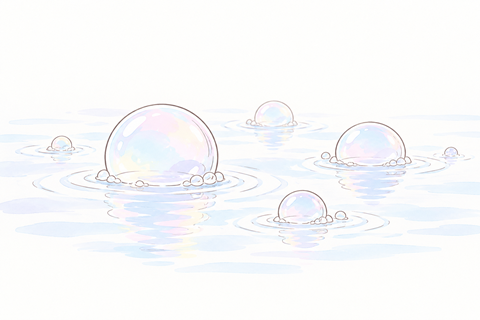
A small bubble appears on the surface of water.
For a moment, it floats there.
It moves gently with the water.
And then—
it is gone.
In Japanese, there is an old and poetic word for something like this:
utakata (うたかた / 泡沫).
Literally, it refers to bubbles or foam floating on water.
But the word can also describe something fleeting — something that appears for only a short time before disappearing.
What Does Utakata Feel Like?
Perhaps three small Japanese sounds can show us.
Fuwa! (ふわっ) — Something Appears Lightly
Fuwa!
Something appears lightly, almost weightlessly.
A tiny bubble rises to the surface.
It does not arrive with force.
It simply appears—
fuwa!
“Fuwa” often expresses something soft, light, or airy.
For utakata, it gives us the feeling of something entering the world gently, without making much of an announcement.
Just for a moment, it is there.

Yura Yura (ゆらゆら) — Drifting Without a Destination
Yura yura…
The bubble floats on the water.
A tiny movement of the surface carries it one way, then another.
Yura yura…
It does not seem to be going anywhere.
It simply drifts.
This gentle, uncertain movement is part of the feeling of utakata.
Something exists—
but nothing holds it in place.

Su! (すっ) — And Then It Is Gone
Su!
A moment ago, the bubble was there.
Now it is not.
No dramatic crash.
No lingering trace.
Just—
su!
Something quietly disappears from sight.
For utakata, this small movement may be the most important of all.
Because the beauty of utakata lies partly in knowing that it cannot stay.

From a Bubble to a Fleeting Life
This is where utakata becomes more than a word for bubbles on water.
A dream can be utakata.
A brief happiness can feel like utakata.
A relationship, a season, or even a human life can be imagined this way.
Something appears.
It stays with us for a little while.
And then it disappears.
Fuwa!
Yura yura…
Su!
The physical image of a tiny bubble becomes a way of thinking about impermanence.

Why Not Simply Say “Fleeting”?
English has words such as fleeting, transient, and ephemeral.
They can express the idea that something does not last long.
But utakata gives that idea a physical image.
There is water.
There is something small floating on its surface.
There is movement.
And there is disappearance.
The abstract idea of impermanence becomes something we can almost see.
Final Thought
Fuwa!
Something appears.
Yura yura…
For a little while, it drifts.
Su!
And it is gone.
None of these expressions means utakata.
But together, they trace its brief existence.
Perhaps that is what makes utakata such a beautiful word.
It does not only tell us that something is fleeting.
It gives that fleetingness a shape:
a small bubble on the water, here for a moment—and then gone.










Comments