
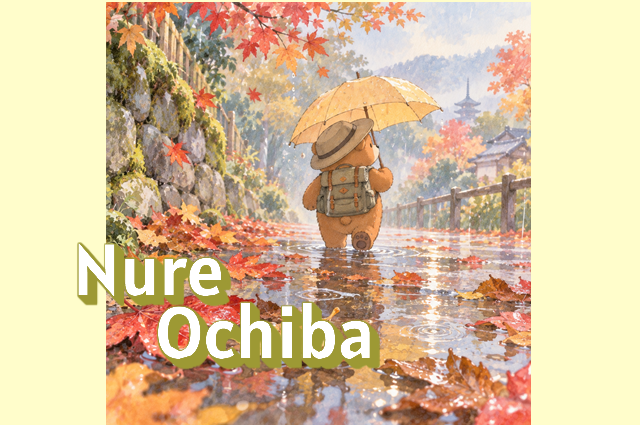
Autumn leaves are beautiful when they flutter down from the trees.
But then it rains.
The leaves become wet.
They stick to the pavement.
And once they are there, they can be surprisingly difficult to remove.
Japanese has a simple expression for them:
nure ochiba (ぬれ おちば / 濡れ落ち葉)
—literally, “wet fallen leaves.”
Nothing mysterious so far.
But nure ochiba has another meaning in Japanese.
And this is where things get interesting.
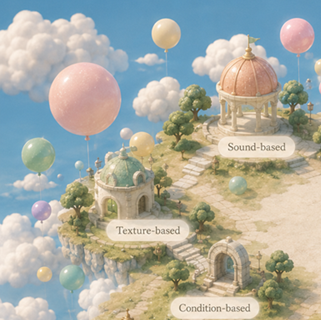
What Wet Fallen Leaves Actually Feel Like?
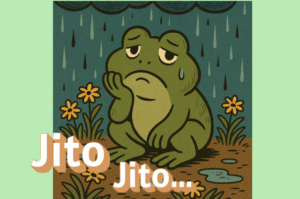
Jito Jito (じとじと) — Damp and Unpleasantly Wet
Jito jito…
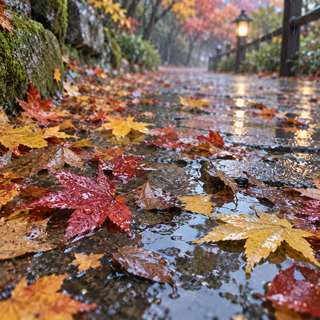
Rain has soaked the fallen leaves.
They are no longer dry and crisp.
They feel damp, heavy, and slightly unpleasant.
Jito jito expresses a persistent kind of dampness or moisture.
It gives us the first part of the nure ochiba image:
the leaves are thoroughly wet.
Pita! (ぴたっ) — Sticking to the Ground
Pita!
A wet leaf lands on the pavement.
And there it stays.
Pita! expresses something making close contact with a surface — fitting or sticking tightly against it.
A dry leaf might blow away in the wind.
A wet leaf does not.
It goes—
pita!
—and sticks.
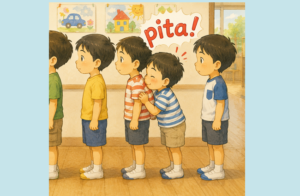
Bettari (べったり) — Stuck There and Not Going Anywhere
Bettari…
Now the leaf is completely pressed against the ground.
Wet.
Flat.
Stuck.
Bettari can describe something clinging closely to a surface.
Unlike pita!, which can capture the moment something sticks, bettari gives us the feeling of it remaining there.
And that difference becomes important.
Because Japanese took this image of a wet leaf that sticks and refuses to go away…
and turned it into a metaphor for a person.
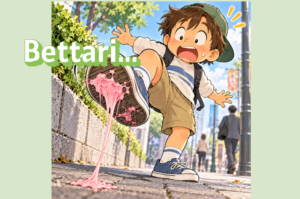
When a Wet Leaf Becomes a Retired Husband
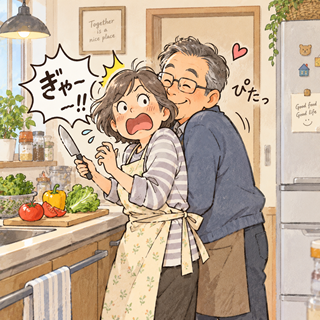
Yes, really.
Nure ochiba has been used humorously — and sometimes rather unkindly — to describe a retired husband who constantly stays close to his wife or follows her around.
After retirement, a man who once spent much of his day at work may suddenly have a great deal of time at home.
His wife goes shopping.
He comes along.
She goes somewhere else.
He comes along again.
He has become—
nure ochiba.
Why?
Think about the leaf.
Jito jito…
It gets wet.
Pita!
It sticks.
Bettari…
And it stays stuck.
The metaphor is not especially flattering.
But the physical image makes its logic immediately understandable.
From Physical Sensation to Human Behavior
This is something Japanese onomatopoeia does particularly well.
A physical sensation can easily become a way of describing human behavior.
Bettari, for example, can describe something physically stuck to something else.
But it can also suggest people being constantly together or someone being overly attached.
The distance between a wet leaf and a human relationship is surprisingly small.
Once we feel the physical image, we can understand the metaphor.
That is what makes nure ochiba such an unusual expression.
It begins on the pavement—
and ends inside a marriage.
Final Thought
A wet fallen leaf does not seem particularly poetic.
Jito jito.
Wet with rain.
Pita!
It sticks to the ground.
Bettari.
It stays there.
And from these very ordinary sensations, Japanese created a rather cheeky metaphor.
A husband retires.
His wife goes out.
And there he is again.
Pita!
Perhaps that is the strange fun of nure ochiba.
Sometimes a Japanese expression does not hide a beautiful landscape or a fleeting moment.
Sometimes…
it hides a joke.





Comments