
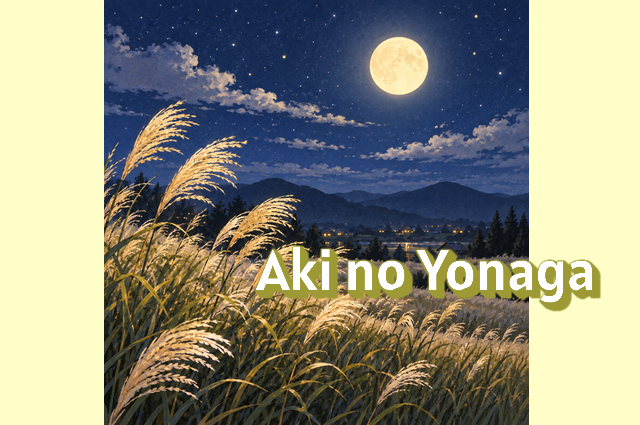
When Japanese people hear the phrase “aki no yonaga” (秋の夜長), they may picture more than simply a night that lasts longer.
A quiet room.
The faint sound of insects outside.
Soft light in the darkness.
And time that seems to pass just a little more slowly.
“Aki no yonaga” literally refers to the long nights of autumn.
The word “Aki no yonaga” (あきのよなが / 秋の夜長) is made up of:
- Aki (あき/秋) — autumn
- Yo (よ/夜) — nights
- Naga (なが/長) — long
But what does an autumn night feel like?
Perhaps Japanese onomatopoeia can help us step inside it.
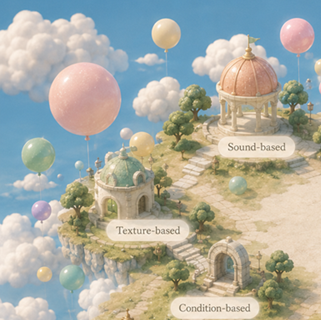
The Sounds and Feelings Inside an Autumn Night

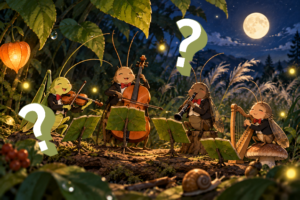
Riin Riin… (りーんりーん) — Insects Singing in the Distance
Riin riin…
A bell cricket calls somewhere in the darkness.
The sound does not fill the whole night.
It seems to appear from inside the silence.
For many Japanese people, the voices of autumn insects are one of the sounds that make an autumn night feel like autumn.
Shiin…(しーん) — The Quiet Around the Sound
Shiin…
Between those small sounds, everything is still.
Shiin expresses a deep silence — the kind of silence that makes tiny sounds seem even clearer.
The night is not completely soundless.
Perhaps that is exactly why it feels so quiet.

Yuttari…(ゆったり) — Time Moving Slowly
Yuttari…
There is no need to hurry.
On a long autumn evening, there may be time to read, drink tea, listen to music, or simply sit and think.
Yuttari suggests a relaxed, unhurried feeling.
“Aki no yonaga” is not only about the number of hours between sunset and sunrise.
It is also about how those hours can feel.

Bonyari…(ぼんやり) — A Soft Light in the Darkness
Bonyari…
A lamp glows softly.
The moon may appear through the window.
Nothing is sharply illuminated.
Bonyari describes something vague, dim, or softly seen — a gentle kind of light that seems at home in a quiet autumn night.

Why Does Japanese Have a Phrase for a Long Autumn Night?
Of course, autumn nights become longer in many parts of the world.
But “aki no yonaga” does more than describe a seasonal change in daylight.
It invites us to notice the night itself.
The insects become easier to hear.
The darkness seems deeper.
Indoor light feels warmer.
And an ordinary evening can feel spacious and unhurried.
Perhaps that is why the phrase appears so naturally with reading, music, tea, and quiet reflection in Japanese culture.

Final Thought
Riin riin…
Shiin…
Yuttari…
Bonyari…
None of these words means “aki no yonaga.”
But together, they may bring us closer to what the phrase feels like.
A long autumn night is not simply long.
It is a night with room in it.
Room to listen.
Room to slow down.
Room to notice the darkness.
That quiet space may be what Japanese people are sensing when they say:
“Aki no yonaga.”








Comments