
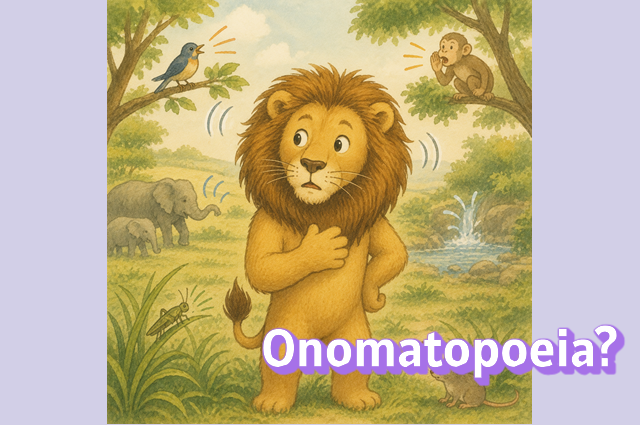
Ever heard someone say “tick tock,” “woof woof,”
or…
“buzz“?
Why Do Humans Make Sound Words?
People everywhere imitate the world around them.
A clock goes tick tock. A bee goes buzz. A dog says woof woof.
These playful expressions help us remember sounds, share feelings, and bring stories to life.
But some languages take this idea even further.
What Is Onomatopoeia?
Onomatopoeia is a word that sounds like what it describes.
Yet in Japanese, sound words are not only about sound.
They can describe movements, feelings, textures, appearances, and even the atmosphere of a moment.
Think of the softness of a pillow, the sparkle of stars, or the nervous beating of a heart.
In short:
onomatopoeia is:
sound + feeling + imagination

Japanese Goes One Step Further
At Puni Puni Dictionary, we use onomatopoeia in a broad sense.
Along with real sounds, we also explore Japanese mimetic words (gitaigo) that describe emotions, textures, movements, conditions, and visual impressions.
| Type | Description | Examples |
|---|---|---|
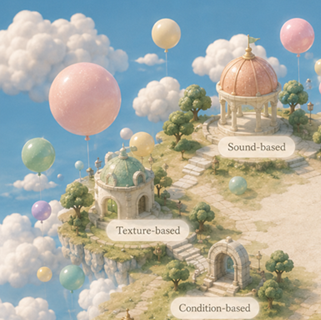
| Sound-based | Audible real-world sounds | buzz (EN), splash (EN), meow (EN), bang (EN) |
| Motion-based | Physical movement or rhythm | zoom (EN), shuffle (EN), click (EN) |
| Emotion-based | Feelings, mood, or internal state | doki doki (JP), hihi (FR) |
| Texture-based | Softness, stickiness, vibration | fuwa fuwa (JP), neba neba (JP) |
| Condition-based | Physical or environmental state | dara dara (JP), jime jime (JP) |
| Visual-based | Visual effects or impression | kira kira (JP), yura yura (JP) |
Why Does This Matter?
Easy to remember. Sound words often sound like what they mean.
Fun to use. They make conversations and stories more vivid.
A window into culture. They show how different people experience the world.
Surprisingly universal. Every language has them, even if they sound different.

The Puni Puni Dictionary Perspective
This website began with a simple question:
The more we explored Japanese sound words, the more we discovered that they are about much more than sound.
They reflect feelings, imagination, culture, and the little details of everyday life.
That is the idea behind The Puni Puni Dictionary Perspective.
Come and explore Japanese sound words—and the world they help us see.
Because sometimes, the best words don’t just describe the world…
They let us experience it.
More Puni Puni Dictionary Perspective






Comments