
Have you ever noticed something curious about Japanese?
Sometimes, one word describes the exact moment something happens…
while another describes the state that follows.
It isn’t a rule that applies to every word.
But once you start noticing it, you may begin to see an interesting pattern.
The Moment
Imagine these scenes.
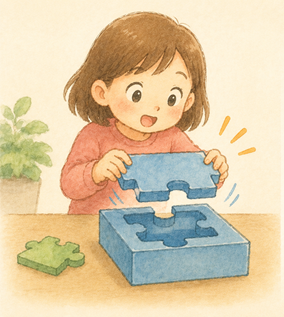
A puzzle piece clicks into place.
Pita!
A hat slips neatly onto your head.
Supo!
A seat belt locks with a click.
Kachi!
Your eyes suddenly open.
Pachi!
These words capture a brief moment—an action that lasts only an instant.
The Result
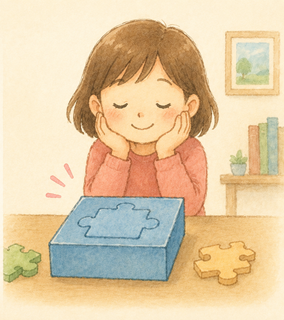
Now look at what happens next.
The puzzle pieces now fit perfectly.
Pittari.
The hat completely covers your head.
Suppori.
Everything is firmly secured.
Kacchiri.
Your eyes are now wide open.
Pacchiri.
Instead of describing the action itself, these words describe the state that remains afterward.
A Pattern Worth Noticing
Here’s one way to look at it.
| Moment | Result |
|---|---|
| Pita! | Pittari |
| Supo! | Suppori |
| Kachi! | Kacchiri |
| Pachi! | Pacchiri |
These examples invite an interesting question:
Does Japanese sometimes enjoy describing both the moment and the feeling that comes after?

A Different Way of Seeing
Many languages naturally describe actions.
Japanese certainly does too.
But Japanese also seems to pay special attention to the state that follows an action.
Not simply:
“It happened.”
but also:
“Now everything feels just right.”
That may be one small reason why Japanese has so many expressions for subtle feelings, appearances, and situations.
Our Perspective
At Puni Puni Dictionary, we don’t think onomatopoeia is only about sounds.
Sometimes, it offers a glimpse into how Japanese speakers notice the world around them.
Perhaps these word pairs aren’t just linguistic coincidences.
Perhaps they reflect a habit of paying attention not only to movement, but also to completion.
Not only to change—
but also to the quiet moment after everything falls into place.
Final Thought
Maybe that’s one of the small joys of learning Japanese.
You don’t just learn new words.
You begin to notice new moments.
And sometimes…
you even notice what comes after the moment.






Comments