
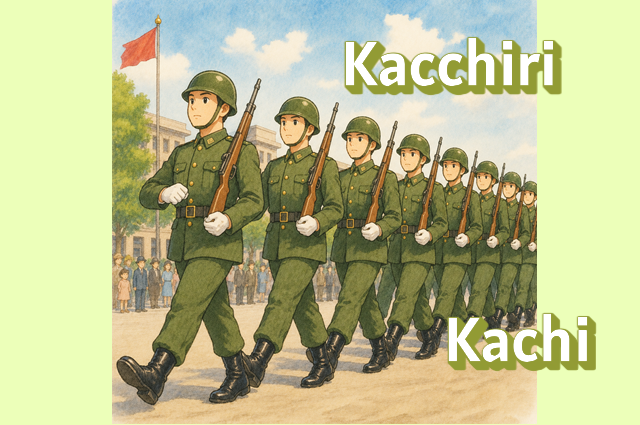
Have you ever fastened a seat belt and heard it click into place?
Then noticed how securely everything stayed in place afterward?
Japanese uses two closely related expressions for these moments:
Kachi! (かちっ!)
Kacchiri (かっちり)

Both express firmness and precision, but one captures the instant of connection, while the other describes the stable result.
Differences Between “Kachi!” and “Kacchiri”
| Expression | Focus | Nuance |
|---|---|---|
| Kachi! | The moment of locking | A crisp click when something becomes secure |
| Kacchiri | The finished state | Firm, neat, secure, and well organized |
In short:
- Kachi! → the instant something clicks securely into place
- Kacchiri → the stable, well-organized result
Examples in Daily Life
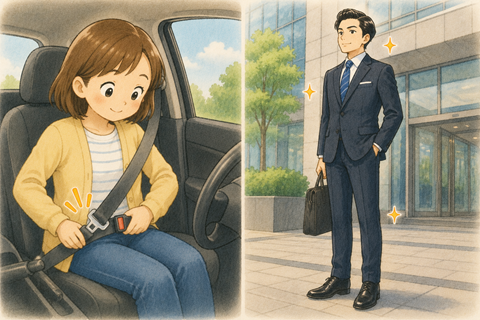
Example 1: Fastening a seat belt (Kachi!)
She buckled her seat belt before driving —
kachi!
Example 2: A neatly dressed businessman (Kacchiri)
He arrived wearing a perfectly tailored suit and polished shoes —
kacchiri.
Try Using Them!
Something clicks firmly into place?
→ Say kachi!
Everything looks neat, secure, and properly arranged?
→ Say kacchiri
Kachi! captures the satisfying click.
Kacchiri describes the dependable result.
One lasts a second.
The other lasts as long as everything stays firmly in place.
Two similar sounds—one marks the moment, the other describes lasting order.








Comments