
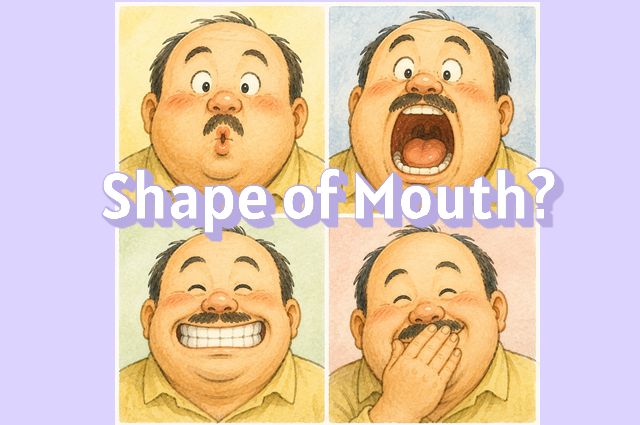
Try saying these two Japanese expressions aloud:
Butsu butsu… (ぶつぶつ……)
Gami gami! (がみがみ!)
They can both be connected with dissatisfaction or complaining.
But they feel remarkably different.
Butsu butsu sounds small and contained.
Gami gami sounds strong and outward.
And something interesting happens when you actually say them.
The difference may not only be something you hear.
You may also feel it in the way your mouth moves.
“Butsu Butsu” — A Complaint That Stays Near the Mouth
Butsu butsu can describe someone muttering complaints quietly, often almost to themselves.
Now try saying it slowly:
bu-tsu-bu-tsu…
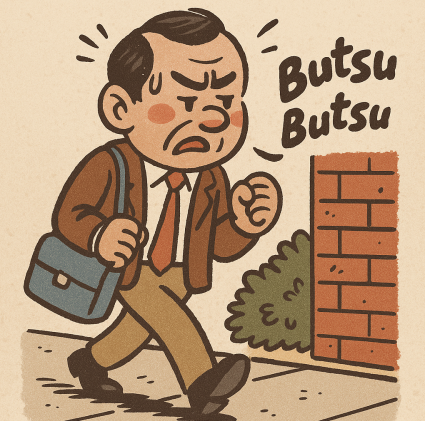
With bu, the lips come together, and the mouth does not need to open very wide.
The repeated sounds can feel small and contained — almost as though the words are staying around the speaker’s lips rather than being projected outward.
That physical feeling seems strangely appropriate for the meaning.
The complaint stays small.
The emotion remains close to the person speaking.
“Gami Gami” — Emotion Directed Outward
Now compare it with:
Gami gami!
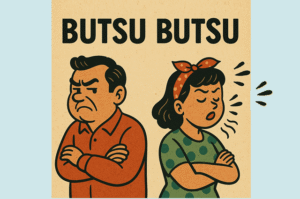
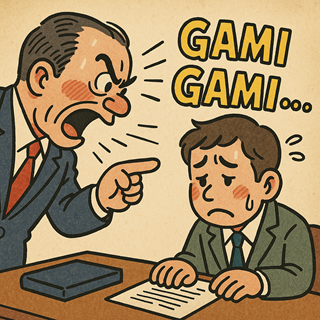
This expression is often used when someone repeatedly scolds or complains at another person in a loud, harsh way.
The emotion is no longer staying quietly with the speaker.
It has a target.
When you say gami gami, the sound feels more open and outward.
So the contrast may be more than:
Butsu butsu → quiet
Gami gami → loud
It can also feel like:
Butsu butsu → inward
Gami gami → outward
The expressions seem to suggest not only the volume of the emotion, but also its direction.
Can the Mouth Become Part of the Meaning?
This raises an intriguing question.
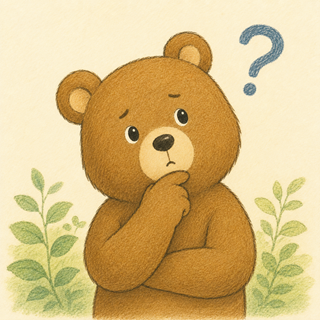
When we use an onomatopoeic expression, are we only hearing its sound?
Or can the physical experience of saying it also contribute to the impression it creates?
From the perspective of Puni Puni Dictionary, butsu butsu offers an interesting example.
The relatively closed, small movement of the mouth seems to fit the image of someone muttering quietly, while gami gami feels much more outward.
This does not necessarily mean that these expressions developed because of these particular mouth movements.
But the resemblance between sound, mouth movement, and meaning is fascinating.
What About “Mu!”?
Consider one more expression:
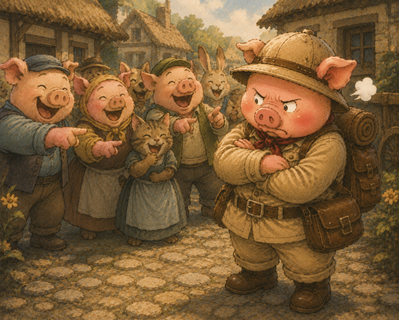
Mu! (むっ!)
It describes a sudden reaction of displeasure or offense.
It is short.
The lips come together.
And the emotion seems to stop there:
Mu!
Again, this does not prove a linguistic rule.
But the expression can feel almost physically compressed.

Listen — But Also Feel
Japanese onomatopoeia is often explored by asking:
What does this word mean?
But perhaps we can ask another question too:
What does it feel like to say it?
Butsu butsu…
The complaint seems to remain near the lips.
Gami gami!
The frustration seems to travel outward.
Mu!
The displeasure appears — and stops abruptly.
These are not fixed rules of Japanese. They are simply one way of looking more closely at the language.
Sometimes, meaning may be something we hear in the sound — and even feel in the movement of our own mouths.









Comments