
Have you ever come across an expression in another language and thought:
Why does it sound like that?
The meaning may be easy enough to understand.
And yet, something about it does not quite feel natural.
Perhaps the sound does not match the image in your mind.
Perhaps you would never have thought of describing that particular feeling, movement, or situation with that particular sound.
Onomatopoeia can sometimes create this kind of small sense of distance between languages.
But perhaps that distance is also interesting.
When Silence Has a Sound
Take the Japanese expression shiin (しーん).
It describes complete silence.
An empty room after everyone has left.
A classroom suddenly becoming quiet.
A moment when nobody knows what to say.
There is no actual sound.
And yet, in Japanese, that silence can be:
shiin…
For someone encountering the expression for the first time, this may seem a little strange.
Why would silence need a sound?
But after seeing shiin in manga, conversations, stories, and everyday situations, perhaps it begins to feel less strange.
Eventually, you may see a completely silent room and think:
Ah. Shiin.
The word has not changed.
Perhaps something in the way you notice the scene has.

When a Feeling Becomes a Movement — and a Sound
Then there is moji moji (もじもじ).
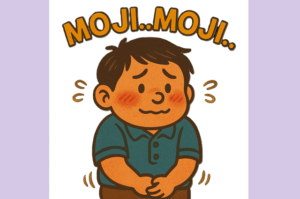
Someone wants to say something but feels shy.
They look down, move slightly, hesitate, perhaps fidget with their hands.
Japanese can gather that mixture of movement, hesitation, and emotion into:
moji moji…
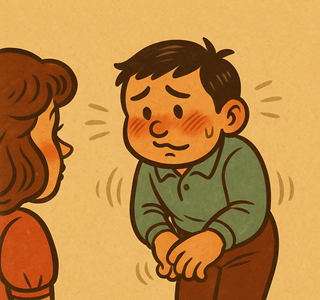
Again, there may be no actual sound.
And translating it into words such as fidgeting or shyly can explain what is happening.
But knowing the definition and developing a feeling for moji moji may not be quite the same thing.
After encountering it again and again, perhaps the expression begins to bring the whole little scene with it.
The posture.
The hesitation.
The tiny movements.
The feeling behind them.
And What Exactly Is “Fuwa Fuwa”?
Fuwa fuwa (ふわふわ) may seem easier.
Something soft and fluffy can be fuwa fuwa.
But so can a cloud.

Hair.
A light blanket.
Something floating gently through the air.
Even the way something moves can sometimes feel fuwa fuwa.
There is no single English word that follows fuwa fuwa everywhere it goes.
Perhaps, then, knowing fuwa fuwa is not simply a matter of finding its English equivalent.
Instead, we gradually begin to recognize the group of sensations that Japanese gathers under this one expression.
And one day, rather than translating it, we may simply look at something and think:
Fuwa fuwa.

A Small Shift in Perspective

Perhaps this is one of the interesting things about getting to know onomatopoeia in another language.
At first, some expressions may feel unfamiliar.
They may divide up sensations differently from the words we already know.
They may give sound to something we never thought of as having a sound.
They may connect a particular sound with a movement, texture, emotion, or atmosphere in a way that would never have occurred to us.
But if we spend enough time with them, perhaps we begin to borrow those connections.
Not completely.
Not necessarily in the same way as someone who has known the language since childhood.
Just a little.
And that little shift may allow us to notice the familiar world from a slightly different angle.
Another Way of Feeling the Same World
Languages do not live in different worlds.
A soft cloud is still a soft cloud.
An awkward silence is still an awkward silence.
A shy person still hesitates before speaking.
But languages may not always draw our attention to those experiences in exactly the same way.
Perhaps that is why an unfamiliar onomatopoeia can sometimes feel so strange at first.
And perhaps that strangeness is worth keeping for a while.
Instead of immediately asking,
“What does this mean in my language?”
we might sometimes ask,
“Why does this language feel it this way?”
There may not always be an answer.
But simply spending some time with that question might let us see something we had not noticed before.
Maybe knowing onomatopoeia is not only about knowing what unusual little words mean.
Maybe it can also give us a small window into another way of feeling the same world.









Comments